
PE100 vs PE80 HDPE Pipe: Material, Strength, Pressure Rating and Applications
PE100 vs PE80 HDPE Pipe is a common comparison for engineers, contractors, and procurement teams selecting polyethylene piping systems for water, gas, mining, irrigation, and industrial projects. The two material grades differ in minimum required strength, pressure capability, wall thickness requirements, material efficiency, and typical project applications. This guide compares PE100 and PE80 by strength, SDR, pressure rating, pipe dimensions, cost, standards, and suitability for different pipeline systems, helping buyers choose the right material for their project conditions.
Table of Contents
PE100 vs PE80 HDPE Pipe: Quick Comparison
When sizing up PE100 against PE80 HDPE pipe, everything boils down to one core metric: the material’s Minimum Required Strength (MRS). PE100 naturally packs a higher MRS. This means you can hit higher pressure ratings—or get away with thinner walls—while keeping the exact same Standard Dimension Ratio (SDR). That distinct mechanical edge has crowned PE100 the go-to standard for heavy-duty, high-pressure infrastructure. PE80, however, still holds its ground perfectly well in targeted, low-pressure scenarios.
Need a quick baseline for your next procurement or engineering spec? The table below lays out the essential technical contrasts between these two polyethylene grades.
| Feature | PE100 HDPE Pipe | PE80 HDPE Pipe |
|---|---|---|
| Material Grade | High-Density Polyethylene (HDPE) | Medium-Density (MDPE) or lower-grade HDPE |
| Minimum Required Strength | 10.0 MPa | 8.0 MPa |
| Pressure Capacity | ~25% higher pressure rating at same SDR | Standard baseline pressure rating |
| Wall Thickness Impact | Thinner wall required for target pressure | Thicker wall required for target pressure |
| Internal Bore / Flow | Larger internal diameter (better flow) | Smaller internal diameter |
| Primary Applications | Municipal water mains, gas, mining slurry | Low-pressure irrigation, rural water, small coils |
What Are PE100 and PE80 HDPE Pipe Materials?
People often mistake PE100 and PE80 for brand names or physical pipe dimensions. They aren’t. They are specific polyethylene material grades categorized entirely by their long-term hydrostatic strength. These numbers simply tell you the performance limits of the raw polymer resin fed into the extrusion line.
PE100 is a high-performance, bimodal polyethylene. It features a high molecular weight alongside a tightly packed chain structure. Thanks to this advanced structural density, PE100 delivers incredible durability and stress resistance. It easily handles punishing environmental conditions and keeps performing for decades.
PE80, on the other hand, is a first-generation unimodal medium-to-high density resin. Sure, its compressive strength and overall density sit a bit lower than PE100. But what it lacks in brute strength, it makes up for in flexibility. That inherent bendability makes PE80 perfect for producing smaller diameter HDPE pipes (usually between 20mm and 63mm) that need to be coiled, transported, and rolled out continuously on-site.
Strength Differences Between PE100 and PE80 HDPE Pipe
An HDPE pipe’s structural integrity hinges entirely on its Minimum Required Strength (MRS). Manufacturers don’t just guess this number. They determine it through brutal, long-term hydrostatic pressure testing. Using ISO 9080 regression analysis, they extrapolate the material’s strength over a 50-year continuous lifespan at a baseline temperature of 20°C.
PE100 hits an MRS of 10.0 MPa, typically boasting an elastic modulus right around 1250 MPa. That kind of structural rigidity means the HDPE pipe pipe can take on massive internal hoop stress without deforming. Beyond raw tensile strength, PE100 fights off both Slow Crack Growth (SCG) and Rapid Crack Propagation (RCP) exceptionally well. If you are protecting high-pressure gas or water mains from catastrophic failure, this crack resistance is non-negotiable.
PE80 clocks in with an MRS of 8.0 MPa and an elastic modulus closer to 950 MPa. That is perfectly fine for low-stress environments. However, put it under intense internal pressure or bury it under heavy external soil loads, and it simply won’t offer the same advanced crack resistance as PE100.
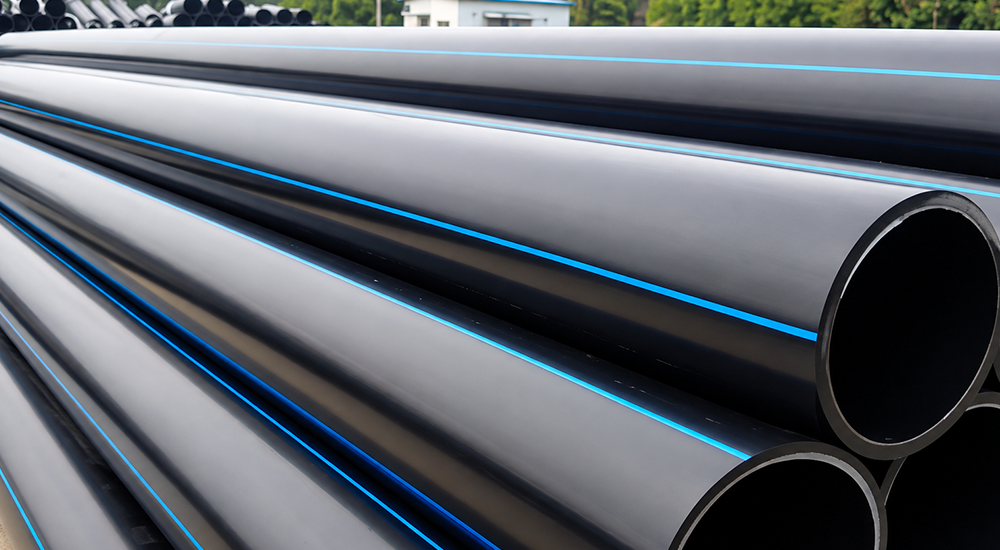
PE100 vs PE80 SDR and Pressure Rating Comparison
Figuring out the relationship between material grade, Standard Dimension Ratio (SDR), and Nominal Pressure (PN) is arguably the most critical math in pipeline design. SDR is just the ratio of the HDPE pipe’s outside diameter to its wall thickness. A lower SDR means a thicker wall. A thicker wall means a higher pressure rating.
Thanks to its superior MRS, PE100 secures a higher PN rating than PE80—even when both HDPE pipes share the exact same SDR.
| Standard Dimension Ratio (SDR) | PE100 Pressure Rating (PN) | PE80 Pressure Rating (PN) |
|---|---|---|
| SDR 11 | PN16 (16 Bar) | PN12.5 (12.5 Bar) |
| SDR 13.6 | PN12.5 (12.5 Bar) | PN10 (10 Bar) |
| SDR 17 | PN10 (10 Bar) | PN8 (8 Bar) |
| SDR 21 | PN8 (8 Bar) | PN6 (6 Bar) |
Want to see what this looks like in the real world? Imagine you are designing a 110mm diameter pipeline that has to handle a PN10 (10 Bar) operating pressure. Go with PE100, and you only need an SDR 17 pipe featuring a 6.6mm wall. Choose PE80, and you are forced to use an SDR 13.6 pipe with a beefier 8.1mm wall just to safely manage that exact same 10 Bar pressure.
Engineers also have to factor in temperature derating. Those nominal pressure ratings we just looked at? They only apply at 20°C (68°F). If your fluid temperature spikes to 40°C (104°F), you have to apply a 0.74 derating factor to the system’s maximum allowable pressure. That rule applies whether you specify PE100 or PE80.
Applications of PE100 and PE80 HDPE Pipe
Picking the right material grade depends entirely on what your project environment demands. Both plastics play critical, yet very distinct, roles in global infrastructure.
PE100 Applications:
- High-pressure municipal potable water supply networks.
- Natural gas transmission and distribution pipelines.
- Mining operations, covering tailings slurry and process water transport.
- Industrial fluid and volatile chemical transport systems.
- Deep-buried infrastructure and trenchless installations, like Horizontal Directional Drilling (HDD).
PE80 Applications:
- Low-pressure agricultural irrigation systems.
- Rural water distribution networks.
- Residential indoor and outdoor water supply lines.
- Legacy pipeline repairs where matching an older, existing wall thickness is necessary.
Operating out of a massive 200-acre facility, JINQUAN manufactures HDPE pipes from a tiny DN16 all the way up to a massive DN3000. This wide production range fully covers both heavy-duty PE100 infrastructure requirements and flexible PE80 agricultural setups.
PE100 vs PE80: Cost, Availability, and Project Economics
If you want to accurately compare HDPE pipe price between PE100 and PE80, you need to look beyond the upfront raw material cost.
By the kilogram, PE100 resin generally costs more to produce than PE80. You can blame its complex bimodal molecular structure for that premium. But surprisingly, PE100 often ends up being the cheaper option when you calculate total installed project costs. Why? Because PE100 hits target pressure ratings using a higher SDR (thinner wall), meaning you buy less plastic per meter of pipe. Shaving off that material volume drastically cuts the pipeline’s overall weight.
Lighter HDPE pipes trigger a cascade of economic benefits. Freight and shipping costs drop. You don’t need as much heavy butt fusion machine for on-site handling. Installation timelines shrink. Backed by an annual production capacity that easily exceeds 100,000 tons, JINQUAN helps optimize these project economics. They do this by providing factory-direct pricing, fast 7-15 day delivery schedules, and export-ready packaging built specifically for global logistics.
How to Choose Between PE100 and PE80 HDPE Pipe
Locking in the right HDPE pipe grade takes a systematic review of your project specs. Procurement managers and field engineers should run through this exact checklist before signing off on any final orders:
1. Transported Medium: Identify the fluid (potable water, natural gas, mining slurry, or harsh chemicals).
2. Operating Pressure: Determine the maximum required Bar or PN rating for the system.
3. Diameter & SDR: Calculate the required DN size alongside the corresponding wall thickness needed for that specific pressure class.
4. Standard Compliance: Verify any mandatory regulatory standards (such as ISO 4427 for water or EN 1555 for gas).
5. Operating Temperature: Assess both fluid and ambient temperatures to see if pressure derating is required.
6. Installation Method: Decide if the pipe will sit in an open trench or be pulled underground via directional drilling (the latter demands PE100’s higher tensile strength).
7. Quantity & Logistics: Tally up the total meterage, check minimum order quantities (MOQ), and map out shipping destination constraints.
8. Certification Requirements: Confirm you have the necessary third-party validations, like CE, SGS, or ISO certificates.
Standards, Certificates, and Quality Checks for PE100 and PE80 Pipes
Bulletproof pipeline infrastructure doesn’t happen by accident; it relies on strict adherence to international manufacturing standards. If you are handling water applications, ensure your buyers specify compliance with ISO 4427-2:2019 or EN 12201-2. Moving gas? ISO 4437 and EN 1555 remain the definitive benchmarks.
Procurement teams can’t just take a HDPE pipe supplier’s word for it. To guarantee material integrity, you have to request specific quality checks. Critical laboratory tests should always include:
- Hydrostatic Pressure Test: PE100 samples need to survive more than 100 hours at 20°C under 12 MPa of stress without a single rupture.
- Oxidation Induction Time (OIT): This metric must exceed 20 minutes. It ensures thermal stability and stops the polymer from aging prematurely.
- Elongation at Break: Look for a result of ≥ 350%. This guarantees material flexibility, stopping brittle fractures when the HDPE pipe is under load.
- Melt Mass-Flow Rate (MFR): Any shift in MFR triggered by the extrusion process cannot exceed ±20%.
JINQUAN rigorously tests for compliance across all these parameters. The facility operates securely under ISO 9001 (Quality Management) and ISO 14001 (Environmental Management) frameworks, backed by official CE and SGS verifications.
Common Mistakes When Comparing PE100 and PE80 HDPE Pipe
A simple specification error on a purchase order can trigger massive budget overruns—or worse, a catastrophic system failure. When you compare HDPE grades, make sure to avoid these prevalent mistakes:
- Comparing Price Without Factoring SDR: Buying PE80 just because the raw material costs less per kilogram is a trap. It ignores the reality that PE80 needs a thicker wall to hit the same pressure rating. The final pipe ends up heavier and is frequently more expensive per meter.
- Ignoring Temperature Derating: Never assume a PN16 pipe can actually hold 16 Bar of pressure at 40°C or 50°C. Elevated temperatures naturally slash the pressure capacity of both PE100 and PE80.
- Using PE80 for High-Pressure Surge Loads: Many engineers forget to account for transient fluid spikes (water hammer). A PE100 SDR 17 pipe easily absorbs recurring surge spikes up to 15 Bar. A comparable PE80 HDPE pipe? It might just rupture.
- Mixing Incompatible Specifications: Don’t specify PE80 for modern municipal gas lines. Strict regulatory standards usually mandate the advanced crack resistance found only in PE100.
- Not Verifying Documentation: Never skip the paperwork. Always request material certificates, hydrostatic pressure test reports, and dimensional inspection data from your manufacturer before the shipment leaves the factory.
PE100 or PE80 HDPE Pipe: Buyer Selection Checklist
Deciding between PE100 and PE80 HDPE pipe ultimately comes down to balancing raw performance needs against strict project budgets.
PE100 is unquestionably the definitive choice for modern infrastructure, high-pressure systems, and massive large-diameter projects. With its superior strength, ability to utilize thinner walls, and proven long-term reliability under heavy stress, it has earned its spot as the premier engineering standard.
On the flip side, PE80 is still a highly viable, budget-conscious option for low-pressure systems, legacy network repairs, and agricultural irrigation. If extreme pressure capacity isn’t a structural requirement—and you really need the flexibility of small-diameter coils—PE80 gets the job done perfectly.
Frequently Asked Questions
Q1: Is PE100 stronger than PE80 HDPE pipe?
Absolutely. PE100 features a Minimum Required Strength (MRS) of 10.0 MPa, easily beating PE80’s 8.0 MPa limit. Because of its higher density and tighter molecular structure, PE100 withstands far more internal hydrostatic pressure over a standard 50-year design life. That makes it the go-to material grade for high-pressure municipal water mains, gas distribution networks, and industrial HDPE pipelines under heavy stress.
Q2: Can PE80 pipe be replaced with PE100 pipe?
Yes, you can replace PE80 with PE100 in nearly every application. Making the upgrade gives you superior crack resistance and a much higher pressure capacity. When swapping out old PE80, engineers often specify a thinner-walled PE100 HDPE pipe (meaning a higher SDR) to hit the exact same pressure rating. This neat trick increases the internal bore, improves hydraulic flow, and drops both pipe weight and material costs.
Q3: What does PE100 mean in HDPE pipe specifications?
When you see PE100 on a spec sheet, it refers to the material’s Minimum Required Strength (MRS). Specifically, it means the polyethylene resin can handle a long-term circumferential hoop stress of 10.0 MPa at 20°C for a full 50-year service life. It is strictly a material classification grade—not a brand name or a HDPE pipe size. It signals high-performance characteristics built for heavy-duty infrastructure and trenchless drilling.
Q4: Which HDPE pipe grade is better for water supply projects?
For modern municipal water supply projects, PE100 almost always takes the win. Its 10.0 MPa strength rating safely manages high-pressure water mains and unpredictable surge loads (water hammer). That said, PE80 is still a highly practical, budget-friendly choice for low-pressure rural water distribution, agricultural irrigation, and small residential service lines where extreme pressure simply isn’t an issue.
Q5: How does SDR affect PE100 and PE80 pipe pressure rating?
The Standard Dimension Ratio (SDR) dictates a pipe’s wall thickness relative to its outer diameter. Since PE100 is structurally stronger than PE80, it naturally hits a higher pressure rating at the exact same SDR. Think of it this way: an SDR 11 PE100 HDPE pipe is rated for PN16 (16 Bar). Take an SDR 11 PE80 pipe, and it only reaches PN12.5 (12.5 Bar) under standard 20°C operating conditions.
Q6: Is PE100 HDPE pipe more expensive than PE80?
Although PE100 raw resin usually costs a bit more per kilogram than PE80, the total installed cost of a PE100 pipeline frequently ends up being cheaper. Because PE100 requires less wall thickness (a higher SDR) to hit your target pressure rating, you consume less plastic per meter. The end result is a lighter HDPE pipe that drastically reduces manufacturing, freight, and on-site handling expenses.
Q7: Can PE100 and PE80 pipes be welded together?
Yes, you can reliably join PE100 and PE80 pipes together if you use electrofusion fittings or mechanical compression fittings. However, butt fusion welding is rarely recommended. You should only attempt it if the HDPE pipes share the exact same wall thickness (SDR) and boast highly compatible melt mass-flow rates. Mixing different material grades during a butt fusion weld can severely compromise the joint’s structural integrity.
Q8: Which certificates should buyers request for PE100 or PE80 HDPE pipe?
B2B buyers must always request compliance certificates proving adherence to international manufacturing standards—think ISO 4427-2 for water or ISO 4437 for gas. You also need essential documentation like hydrostatic pressure test reports, Oxidation Induction Time (OIT) results, and raw material datasheets. Finally, double-check that the factory actually holds ISO 9001 (quality management) and ISO 14001 (environmental management) certifications, alongside trusted third-party validations like CE or SGS.
Conclusion
Getting a grip on the distinct engineering profiles of PE100 and PE80 HDPE pipe is the best way to optimize both pipeline performance and project budgets. With a 10.0 MPa Minimum Required Strength, PE100 delivers the heavy-duty structural rigidity needed for high-pressure municipal, gas, and industrial infrastructure. It lets you use thinner walls while boosting hydraulic flow. Meanwhile, PE80 (rated at 8.0 MPa) still holds immense value as a highly flexible, cost-effective solution for low-pressure agricultural and rural networks. Success ultimately depends on matching the right material grade to your specific operational pressures, target SDR, fluid temperatures, and international standards. Doing so guarantees long-term pipeline longevity and a smooth installation.