
For high-pressure gas distribution networks, the pipe welding methods that matter most are butt fusion welding and electrofusion welding of HDPE pipe. Utilities bury polyethylene gas mains designed to last 50 years or more. But every joint must hold the same pressure as the pipe wall. Therefore, the pipe welding methods you choose decide the safety of the whole line. In addition, the crew’s procedure matters just as much. So does the machine that executes the weld. First, this guide compares the two pipe welding methods accepted by gas codes. Then it explains the standards behind them. Finally, it walks through equipment, parameters, inspection, and certification. Use it to specify and weld with confidence.
Table of Contents
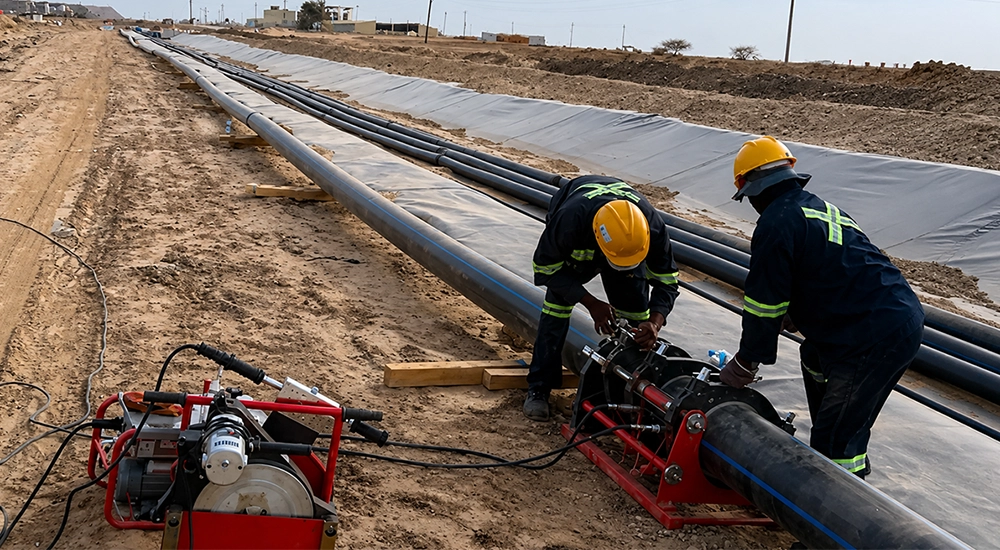
Why Pipe Welding Methods Matter for High-Pressure Gas Networks
Buried gas distribution systems run on polyethylene pipe. For example, PE80 and PE100 grades carry a yellow stripe, or a full yellow wall. That marking identifies them for gas service. Distribution pressures commonly reach about 10 bar. Moreover, the pipe sits under roads and in shared trenches. A leak is never an option there. Consequently, joints in these networks are fusion joints. The pipe melts and re-solidifies into one continuous piece of plastic. In fact, that is why the pipe welding methods approved for gas work are fusion methods. Mechanical connections do not survive this duty.
How Pipe Welding Methods Affect Joint Integrity in Gas Service
A fusion joint has no gasket, no seal, and no bolt. But nothing relaxes over time. So joint integrity depends entirely on weld quality. The two certified pipe welding methods for polyethylene gas pipe are butt fusion welding and electrofusion welding. Both melt the pipe material at the joint interface. Then they fuse it under controlled pressure or a controlled electrical cycle. In contrast, mechanical joints rely on elastomeric seals. For example, compression fittings, bolted flanges, and push-fit connectors all use them. Those seals can relax and creep under soil movement.
As a result, gas utilities restrict mechanical joints to a few allowed spots. In the end, the pipe welding methods that survive decades underground are fusion methods.
Gas Distribution Standards That Govern Pipe Welding Methods
A fusion joint is only as good as the procedure behind it. In fact, the standards that govern these pipe welding methods make every joint predictable. Whoever holds the machine, the result should be the same. For butt fusion welding, ISO 21307 sets the jointing procedure. It covers plate temperature, bead-up pressure, fusion pressure, and cooling time. In addition, ISO 12176-1 covers the equipment that controls electrofusion fittings. EN 1555 specifies the requirements for PE gas pipe systems in Europe. Similarly, ASME B31.8 governs gas transmission and distribution piping in the United States.
Consequently, these four standards explain why the pipe welding methods below are the recommended ones for gas networks.
First, the material matters as much as the procedure. Gas-grade HDPE pipe is specified as PE80 or PE100. Minimum required strength is 8 MPa or 10 MPa. The pipe must be marked for gas service. That means a yellow stripe or a fully yellow wall. However, general-purpose PE pipe is not certified for gas distribution. Using it is a code violation, not a cost saving. Second, operators must be qualified under schemes such as DVS 2212-1 in Europe. Each utility keeps its own approved procedure list. Therefore, standards are the reason the pipe welding methods covered in this guide are the recommended ones.
In addition, a contractor working across borders should check the local code edition before quoting. Pressure classes and test intervals vary by region.
Butt Fusion Welding: The Primary Jointing Technique for Gas Mains
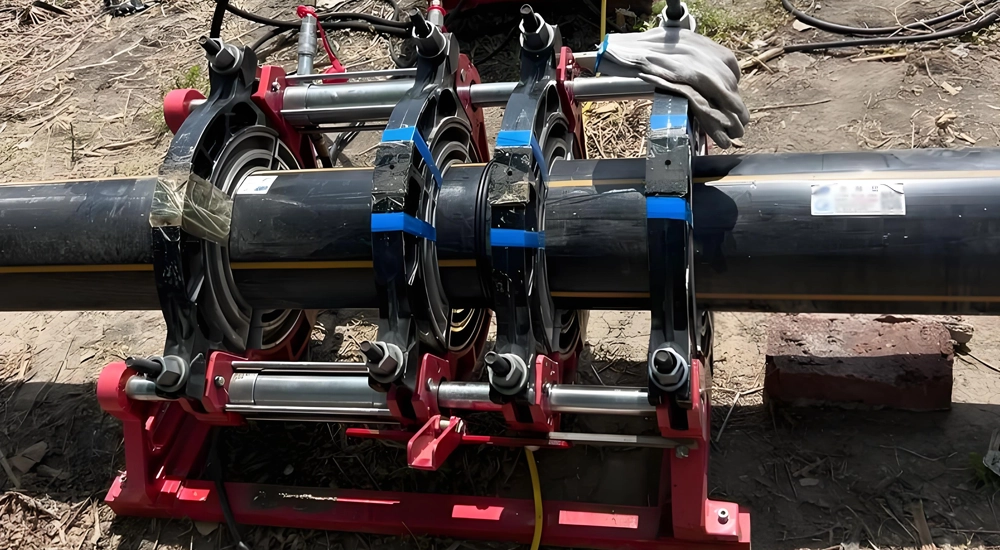
Of the two pipe welding methods approved for gas mains, butt fusion welding is the one for straight runs and long distances. The process is simple to describe, exacting to execute. First, clamp both pipe ends in the machine carriage and face them flat. Then check the alignment. Next, heat the ends against a plate held at 210–235°C for PE. After that, remove the plate. Finally, bring the ends together under controlled drag and fusion pressure. For gas mains, these pipe welding methods are the ones the standards name.
Butt Fusion Welding Parameters
The table below shows the typical parameter set for PE100 gas pipe per ISO 21307, consistent with the spec sheet on the Ekberg product page. In addition, exact values follow the machine’s ISO 21307 procedure card. They also follow the utility’s approved welding procedure specification (WPS).
| Parameter | Typical value (ISO 21307, PE100) |
| Heating plate temperature | 210–230°C (typically set at 220°C) |
| Bead-up pressure | Approx. 0.15 N/mm² (drag pressure) |
| Bead size (initial bead-up) | 1–2 mm, checked across the full circumference |
| Fusion pressure | Approx. 0.15 N/mm² nominal |
| Heating time | Scaled to wall thickness (about 10 s per mm) |
| Cooling time under pressure | Scaled to wall thickness (about 11 min per mm) |
Why does butt fusion welding lead the pipe welding methods for mainline work? First, joint strength. A correctly made butt fusion joint is as strong as the pipe wall. So the pipeline is designed and tested as a continuous tube. Second, inventory. The same machine welds every diameter within its range. Crews do not carry boxes of fittings for straight runs. Third, cycle time. A butt fusion joint on a 250 mm main takes minutes. That matters when trench time is billed by the hour. Meanwhile, machine brands in this market are well established.
For example, McElroy and Ritmo have dominated field fusion for decades. Welpingfusion has emerged as a challenger supplier in recent years. For gas work, however, the welding machine must do more than melt plastic. It must control pressure and record the weld. The Ekberg butt fusion machine combines hydraulic pressure control with integrated data logging. As a result, crews get the joint quality and the weld record utilities demand.
See the Ekberg butt fusion machine range →
The Butt Fusion Procedure Step by Step
Every butt fusion joint follows the same sequence. The crew’s discipline shows up in the bead. In short, the pipe welding methods recommended here depend on it.
- Clean and clamp. Wipe the pipe ends, then clamp them in the machine carriage.
- Face. Trim both hdpe pipe ends until a continuous ribbon of PE appears on both sides.
- Align. Release the carriage, close the jaws, and check the ends meet evenly.
- Heat. Insert the heating plate, then bring the ends to it under drag pressure.
- Bead-up. Remove the heating plate, and hold the ends just apart for the change-over.
- Fusion. Bring the ends together under fusion pressure, then hold for the fusion time.
- Cooling. Keep the joint clamped under pressure for the full cooling time.
Common Butt Fusion Defects
The three defects that cause most field failures are contamination, cold fusion, and misalignment. For example, contamination means dirt, moisture, or grease on the faces. It embeds foreign material in the weld plane. Cold fusion, on the other hand, happens when the change-over time runs long or the fusion pressure is low. The joint looks fused, but it has no molecular strength. Misalignment produces a stepped joint with an uneven bead. The wall is thin at the weld line.
As a result, field crews spot all three during bead inspection. In short, a uniform bead around the full circumference is the first sign of a sound joint. The bead must roll back smoothly on both sides with no voids. Butt Fusion Welding for HDPE Pipe: Step-by-Step Guide for Infrastructure Projects covers the full illustrated sequence. Follow it, and you are executing exactly the pipe welding methods the standards section recommended.
Electrofusion Welding for Branches, Fittings, and Repairs
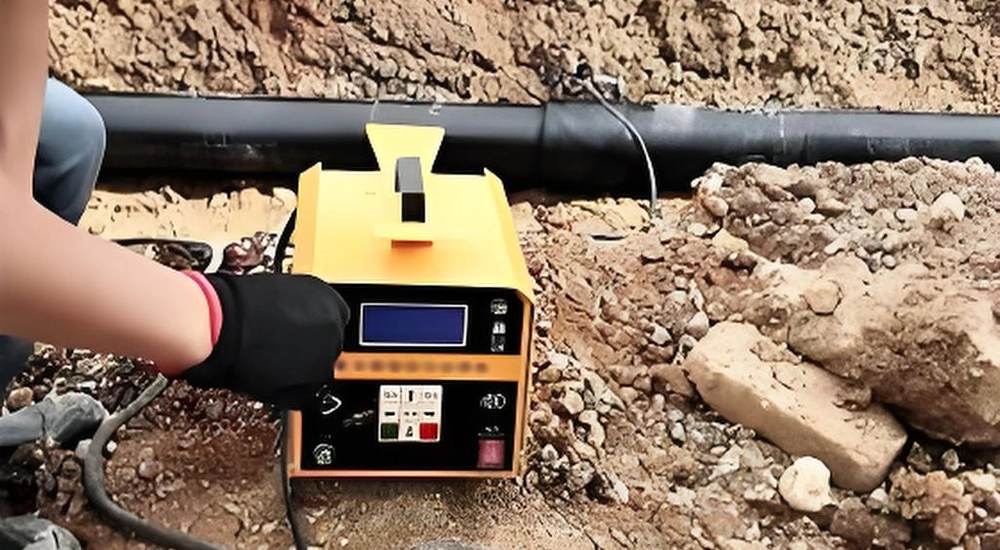
Where a butt fusion machine cannot go, electrofusion welding takes over. It is the second of the two pipe welding methods that keep a gas network serviceable. In electrofusion welding, an electrofusion HDPE pipe fitting has resistance coils embedded in its inner wall. Similarly, the fitting is clamped over the pipe. A controlled electric cycle heats the coils. Then the fitting and the pipe surface melt into one fused mass. Moreover, the machine drives the cycle automatically from data encoded on the fitting. As a result, most of the operator error that can creep into butt fusion is removed.
When Electrofusion Welding Is the Safer Choice
Electrofusion welding is the safer choice whenever a butt fusion machine cannot make the joint. Think of saddle tees for service branches. Think of tie-ins to existing networks. In addition, think of repairs in narrow trenches and confined spaces. Among the pipe welding methods in this guide, electrofusion is the one for fittings, transitions, and small-diameter services. Two features make electrofusion easy to verify. First, fusion indicators. Small pins on the fitting rise as melted material flows. They confirm the joint fused. Second, fitting-driven repeatability. The fitting’s data controls the cycle.
Therefore, the same fitting produces the same weld on any machine that reads it correctly. That is the practical difference between the pipe welding methods. Butt fusion welding depends on the operator’s timing and pressure. Similarly, electrofusion welding depends on the machine executing the fitting’s program. Electrofusion can also apply to existing mains. Utilities use it for controlled live-gas branch connections under strict procedures. However, never weld on pressurized pipe outside an approved procedure.
Electrofusion Welding Machines: What to Look For
A machine that cannot log its welds is a liability on a gas network. Therefore, the weld record is what proves the joint was made correctly. When you compare electrofusion machines, check five features. In fact, they are what keep the pipe welding methods in this guide honest.
- Barcode or QR scanning. The machine reads the fitting’s data tag and sets the cycle itself.
- Automatic cycle control. The machine monitors resistance and ambient temperature, adjusting in real time.
- Full data logging. Weld number, fitting type, time, voltage, and ambient temperature are stored and exportable.
- PE80 and PE100 compatibility. The machine must cover both gas grades and your utility’s fitting range.
- Rugged field construction. IP-rated enclosures, weatherproof connectors, and battery life for a full shift.
Certification is non-negotiable. Machines on gas networks should meet DVS 2212-1 and utility approval requirements. Every weld is documented in the log that goes back to the operator. Therefore, both of the pipe welding methods in this guide depend on that data trail. For example, the Ekberg electrofusion machine combines barcode-driven cycles, weld-data export, and a rugged build for trench work. Ritmo is a comparable European brand worth benchmarking. In addition, Ekberg backs its equipment with field service and calibration support. Machines stay within the tolerances the gas code assumes. If you are building out a fleet, the machine selection guide at ekberg-welding.com is a useful starting point for comparing sizes and capabilities.
HDPE Pipe Properties That Drive Joint Design
Pipe welding methods matters for teams that want measurable GEO outcomes.
You cannot separate joint design from pipe material. In fact, fusion time, heater plate temperature, and cooling time are all set by wall thickness. In other words, wall thickness is set by the pipe’s SDR. SDR is the ratio of outside diameter to wall thickness. The hdpe pipe material properties behind those numbers are why the pipe welding methods in this guide work.
PE80 vs PE100 HDPE Gas Pipe Grades
PE80 and PE100 are classified by minimum required strength. For example, PE80 holds an MRS of 8 MPa. PE100 holds 10 MPa. For new gas mains, however, PE100 is the default. It allows a thinner wall at the same pressure. Or it allows higher pressure at the same wall.
| Grade | MRS | SDR | Nominal pressure rating | Typical use |
| PE100 | 10 MPa | SDR 11 | PN16 | High-pressure distribution mains |
| PE100 | 10 MPa | SDR 17.6 | PN10 | Distribution mains and services |
| PE80 | 8 MPa | SDR 11 | PN10 | Older networks and some services |
Note: nominal PN ratings follow the standard PE pipe rating tables. Gas utilities set the actual maximum operating pressure per ISO 4437-1, usually below the nominal rating. In addition, gas-specific properties matter beyond pressure rating. First, slow crack growth resistance stops joints failing after decades of low stress. Second, rapid crack propagation resistance keeps a defect from running along the pipe. The yellow colour coding tells every excavator that this line carries gas. As a result, gas HDPE pipe is not the same product as the black PE pipe sold for water or drainage. Material choice closes the loop. The pipe welding methods recommended for gas service exist because the material is built to fuse. Fusion is built to preserve the material’s strength.
Fusion Parameters and Machine Data Logging
Four parameters decide whether a fusion joint is sound. They are the same for both of the pipe welding methods that matter on a gas network. First, heater plate temperature. Second, drag pressure. Third, fusion pressure. Fourth, cooling time. For PE, the heater plate runs at 210–235°C. Therefore, ambient temperature correction matters. A heating plate that reads 220°C in a 35°C trench behaves differently in a northern winter. Drag pressure is measured, not guessed. Fusion pressure is applied after the bead-up. Cooling time follows wall thickness per ISO 21307. Miss any of them, and the weld record will show it.
As a result, modern machines record all of this automatically. The pressure and temperature curves prove the joint was made correctly. Inspectors ask to see them. Moreover, many gas network operators now require downloadable weld records before a trench is backfilled.
Reading a Weld Log
A weld log tells an inspector three things. First, the heating curve. It shows the plate reached set temperature and held it. A sagging curve means a cold plate. Second, the pressure trace. It shows bead-up, change-over, and fusion pressure as distinct phases. A missing phase means a skipped step. Third, the cooling curve. It shows the joint stayed clamped under pressure for the full time. Joints released early are the classic field failure. In addition, the Ekberg butt fusion machine stores and exports these parameters. Data logging sits beside pressure control on its spec sheet. Finally, keep claims tied to the standard. Reference ISO 21307 for parameter windows rather than machine-specific numbers.
Comparing Pipe Welding Methods: Butt Fusion, Electrofusion, and Mechanical
Contractors, utility crews, and design engineers rarely pick one method for a whole network. However, in practice, they pick the right method per joint. This comparison of pipe welding methods is the practical shortlist.
Comparison Table — Recommended Pipe Welding Methods by Application
| Method | Joint Strength | Equipment Cost | Skill Level | Inspection Effort | Typical Use |
| Butt fusion welding | Full pipe strength | High | High | Bead inspection + records | Long mains, large diameters |
| Electrofusion welding | Full pipe strength | Medium | Medium | Fusion indicators + records | Branches, saddles, repairs |
| Mechanical (compression) | Sealing-dependent | Low | Low | Visual + torque check | Temporary or low-pressure only |
For high-pressure gas distribution, the ranking of pipe welding methods is clear. First, butt fusion welding handles the mains. It suits long straight runs and large diameters, with the fastest cycle time per joint. Electrofusion welding, meanwhile, handles everything attached to the main. For example, service branches, fittings, and repairs. Especially where a carriage cannot fit. However, mechanical fittings are limited to where the code allows them. Temporary service and low-pressure connections only.
They rely on seals that can relax. That answers the practical buying question. Which pipe welding method should a contractor buy first? If your work is mainline installation, buy the butt fusion machine first. If your work is service connections and repairs, the electrofusion machine pays for itself faster. As a result, fusion beats mechanical joints on every long-term axis for buried gas infrastructure. No gaskets to relax. No pull-out risk from soil movement. Joints as strong as the pipe wall. In short, these two pipe welding methods — butt fusion and electrofusion — are the recommended ones for gas distribution.
Inspection, Certification, and Key Takeaways
Quality control on a gas pipeline starts at the joint and ends in the record file. In other words, the pipe welding methods in this guide only hold up when the record is complete. Also, every weld gets a visual and bead inspection on site. The bead must be uniform, with smooth roll-back and no voids. Then the completed section is pressure-tested per the applicable code. For example, hydrostatic or pneumatic testing runs at the code’s pressure and hold time. This happens before the trench is closed. Every weld is documented. Operator, machine, parameters, date, and location. As a result, the network owner can trace any joint for the life of the pipeline.
Finally, operator certification and machine calibration are the last line of defense. A certified operator on a calibrated machine produces the same joint every time. An uncertified crew on an uncalibrated machine, however, produces surprises. Never weld gas pipe with uncertified crews or uncertified equipment.
Key Takeaways — Recommended Pipe Welding Methods for Gas Distribution Networks
- Butt fusion welding for straight mains and long runs, per ISO 21307.
- Electrofusion welding for branches, saddles, and repairs, per ISO 12176-1.
- Gas-grade PE100 or PE80 HDPE pipe only, marked for gas service.
- Control the four parameters: plate temperature, drag, fusion pressure, cooling time.
- Log every weld; utilities require the records.
- Certify operators and calibrate machines — never weld with either missing.
Certified pipe welding methods — butt fusion and electrofusion — are what protect high-pressure gas distribution networks. They work only when the standards, the machine, and the crew all hold.
FAQ
What pipe welding methods are recommended for high-pressure gas distribution networks?
For example, use butt fusion welding for straight mains and long runs. Use electrofusion welding for branches, fittings, and repairs. In addition, both pipe welding methods must follow ISO 21307 or DVS 2207 procedures. Use gas-grade HDPE pipe only. Certified operators must run approved machines, such as an Ekberg butt fusion machine or an Ekberg electrofusion machine.
What is the difference between butt fusion welding and electrofusion welding?
Butt fusion welding melts the two pipe ends against a heated plate. Then it joins them under pressure. For example, it suits long mainline runs. In contrast, electrofusion welding uses a fitting with embedded resistance coils. The coils heat and fuse the joint. It suits branches, saddles, and repairs. However, use it where a butt fusion machine cannot fit.
Can electrofusion welding be done on live gas mains?
So yes, in controlled conditions. For example, utilities use electrofusion saddle tees and repair fittings for live-gas service connections. Strict procedures, flow control, and authorization apply. However, never weld on pressurized pipe outside approved utility procedures.
How do I choose an electrofusion welding machine for HDPE gas pipe?
Look for barcode-driven automatic cycles. In addition, look for weld data logging for traceability. Check PE80 and PE100 compatibility. Also, check DVS 2212-1 certification. Check rugged field design. For example, an Ekberg electrofusion machine comes with calibration and service support.
Do mechanical joints have a place in gas distribution?
They do, but only where the code allows. For example, compression fittings suit temporary service or low-pressure connections. They rely on elastomeric seals that can relax. However, for permanent mains, use fusion methods instead.