
How to Select Butt Fusion HDPE Fittings for Different Pipe Sizes and SDR Ratings
Butt Fusion HDPE Fittings selection depends on pipe diameter, SDR rating, pressure class, and fitting type. This guide shows how to match dimensions, avoid compatibility errors, and choose the right option for reliable pipeline performance.
Table of Contents
What Are Butt Fusion HDPE Fittings and Where Are They Used?
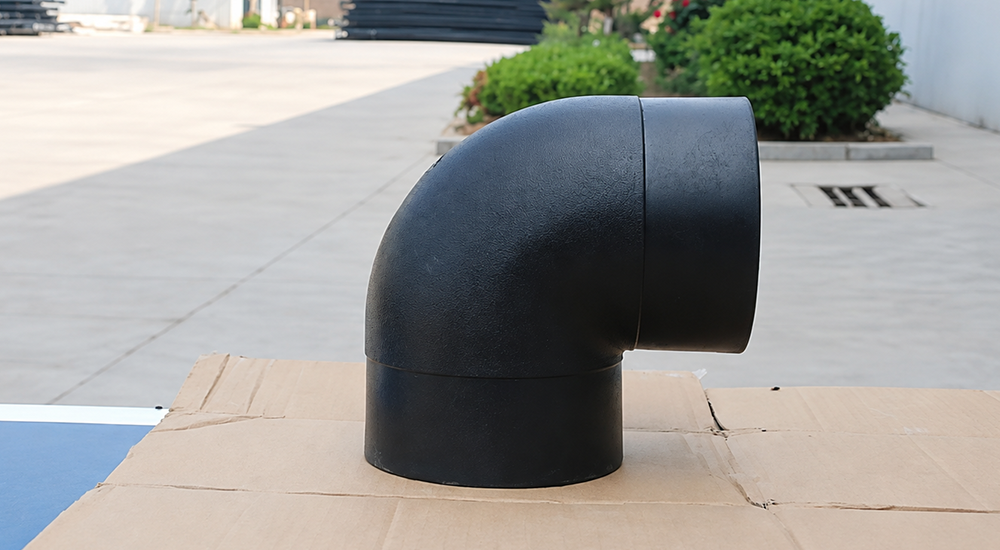
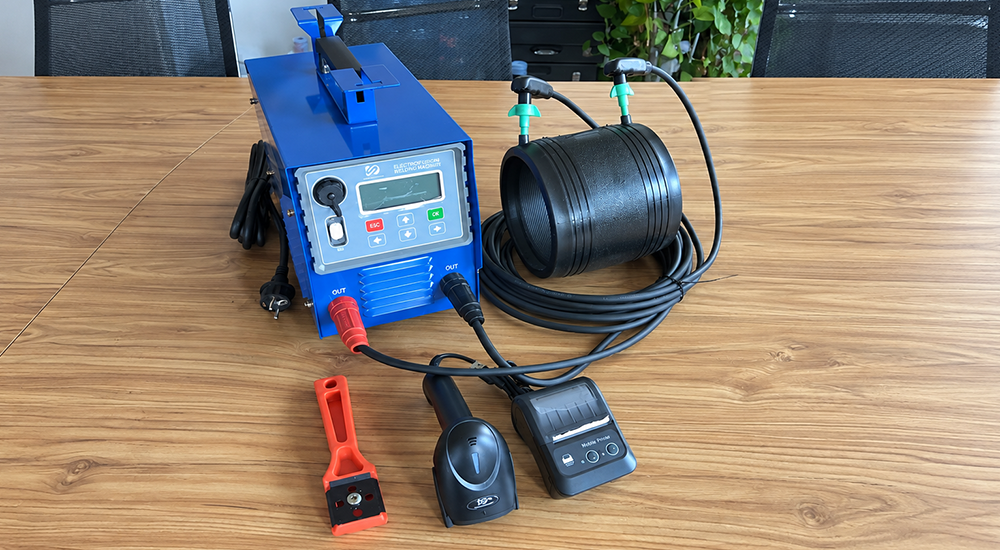
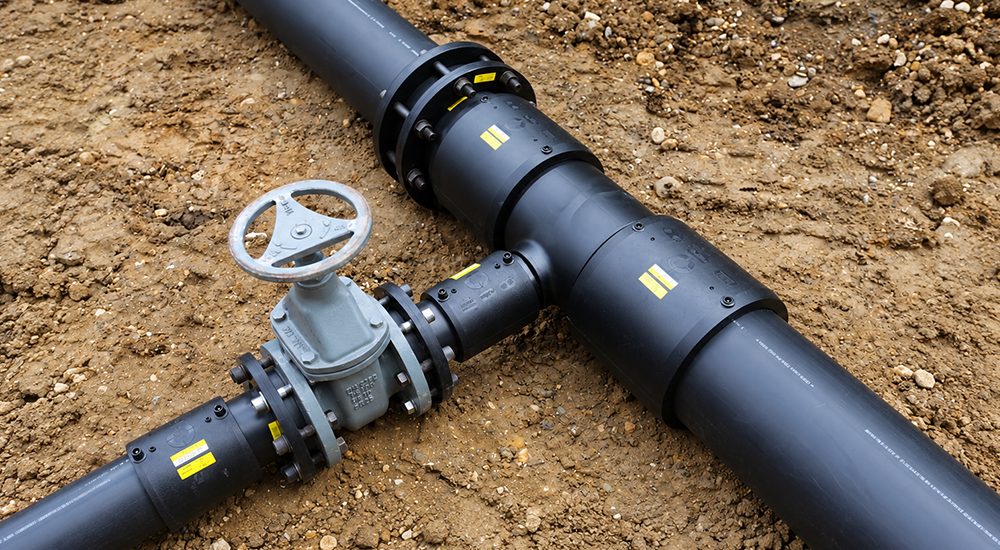
Butt fusion HDPE fittings serve as critical thermoplastic connectors designed to link straight pipe sections, redirect flow, or adjust pipeline diameters. Operators join these components to the primary pipeline using a specialized butt fusion machine. This equipment simultaneously heats the pipe end and the fitting face until both reach a molten state. After melting, controlled hydraulic pressure forces the two pieces together. As the plastic cools down, it creates a single, continuous, leak-proof joint. Impressively, this fused connection frequently boasts greater strength than the original pipe.
You will typically find these HDPE pipe fittings in medium to large-diameter setups, spanning DN50 to DN3000. They play a vital role in municipal water grids, mining slurry operations, agricultural irrigation, and high-pressure fluid or gas transmission lines. JINQUAN produces these components from premium PE80 and PE100 resins. Supporting an extensive size range from DN16 to DN3000, they guarantee smooth integration across demanding industrial and municipal projects.
Why Pipe Size and SDR Rating Must Match
Absolute dimensional alignment stands as the golden rule of butt fusion. If you want a flawless monolithic joint, the pipe and the HDPE pipe fitting need identical Outside Diameters (OD) and Standard Dimension Ratios (SDR).
Trying to fuse parts with different wall thicknesses—like pairing an SDR 11 fitting with an SDR 17 pipe—spells trouble. It triggers uneven heating and produces an irregular melt-bead geometry. Forcing these mismatched walls together generates intense stress concentrations right at the joint interface. Under normal operating pressure, that connection has a remarkably high chance of failing.
Sometimes, a project design demands connecting two different SDRs. In that scenario, butt fusion is off the table. Engineers need to pivot to electrofusion fittings for HDPE pipe, which handle slight SDR differences much better. Alternatively, a mechanical flanged transition works perfectly to bridge the mismatched wall thicknesses without compromising safety.
Common HDPE Butt Fusion Fitting Types
Choosing the right manufacturing style for your butt fusion HDPE fittings boils down to two main factors: pipeline diameter and system pressure demands.
| Fitting Type | Manufacturing Method | Common Forms | Size Range | Pressure Rating Characteristics |
|---|---|---|---|---|
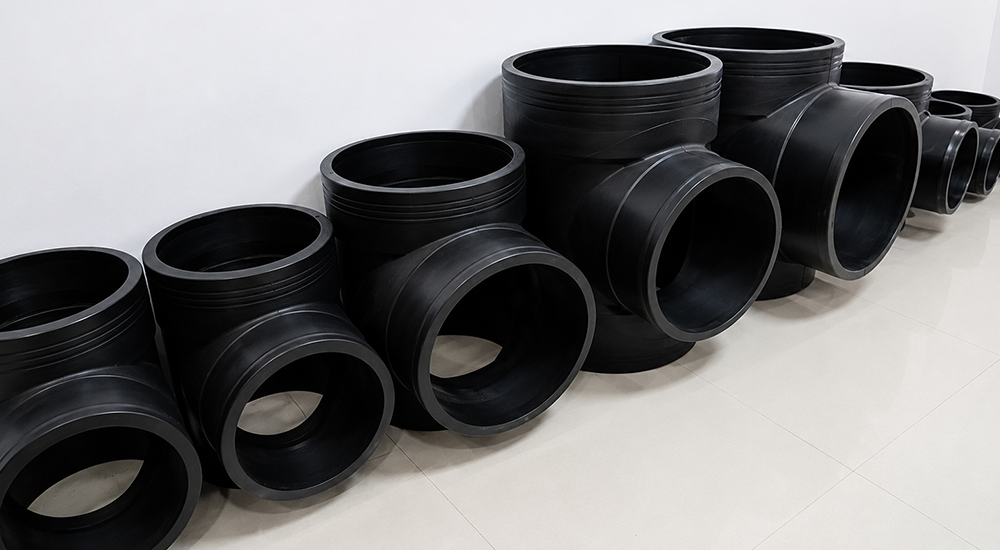
| Molded | Single-piece injection molding | 45°/90° elbows, equal/reducing tees, concentric/eccentric reducers, end caps | Up to DN500–DN630 | Carries the full pressure rating of the pipe (no derating required). |
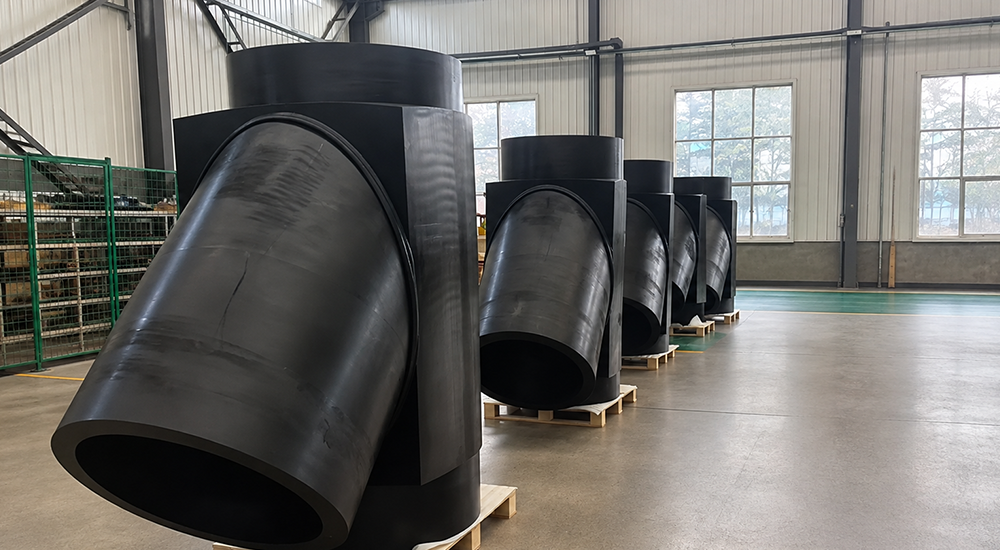
| Fabricated | Segmented and welded from HDPE pipe | Segmented elbows, fabricated tees, custom sweeps | >DN630 up to DN3000 | Requires pressure derating. Often built from a thicker SDR (e.g., DR 9 fitting on DR 11 pipe) to maintain system pressure. |
| Stub Ends | Molded or machined | Flange adapters | DN50 to DN3000 | Used with a PP-coated or galvanized backing ring to create a dismantlable bolted joint for valves or metal pipes. |
Thanks to their seamless build and consistent pressure capabilities, molded butt fusion HDPE fittings remain the go-to choice for everyday municipal and industrial jobs. Yet, some projects demand massive pipe diameters that push past the physical constraints of injection molding equip
How to Match HDPE Fitting Size to Pipe Diameter
Industry standards size HDPE pipe systems strictly by their controlled Outside Diameter (OD). If a blueprint specifies a DN315 pipe, that pipe measures exactly 315mm across the outside. Naturally, you must pair it with a DN315 butt fusion fittings for HDPE pipe.
The SDR formula clearly outlines the relationship between this outside diameter and the pipe’s wall thickness:
SDR = Outside Diameter (OD) / Minimum Wall Thickness (t)
Before matching sizes, double-check if your project relies on metric or imperial measurements. JINQUAN works heavily with metric DN sizing (DN16–DN3000), the dominant standard throughout European, Asian, and Middle Eastern regions. Never mix metric (mm) and imperial (inches) components. Doing so creates tiny OD discrepancies that will ultimately ruin the fusion process.
Dimensional Parameter and Pressure Check Table (PE100 at 20°C)
| Nominal Size (OD) | SDR 17 Wall Thickness | SDR 17 Pressure | SDR 11 Wall Thickness | SDR 11 Pressure |
|---|---|---|---|---|
| DN110 (110mm) | 6.6 mm | PN10 (10 bar) | 10.0 mm | PN16 (16 bar) |
| DN160 (160mm) | 9.5 mm | PN10 (10 bar) | 14.6 mm | PN16 (16 bar) |
| DN315 (315mm) | 18.7 mm | PN10 (10 bar) | 28.6 mm | PN16 (16 bar) |
How SDR Rating Affects HDPE Fittings
A HDPE butt fusion fitting’s structural strength directly ties back to its Standard Dimension Ratio. Lower SDR numbers point to thicker walls relative to the overall diameter, meaning the component can handle a higher pressure rating (PN).
When working with modern PE100 material at a baseline temperature of 20°C (73°F), predicting these pressure limits is straightforward. Take an SDR 11 butt fusion HDPE fittings, for instance. It carries a PN16 rating, effortlessly managing 16 bar (roughly 200 PSI) of internal pressure. On the flip side, an SDR 17 butt fusion HDPE fitting has a thinner wall and tops out at PN10, or 10 bar (around 125 PSI).
The actual differences in wall thickness are striking. A DN315 SDR 11 HDPE pipe fitting demands a hefty 28.6 mm wall. Meanwhile, that exact same DN315 size in SDR 17 drops down to just 18.7 mm. To ensure compatibility, these dimensions must align perfectly. Also, keep fluid temperatures in mind. If your pipeline moves hot liquids, those standard 20°C pressure ratings go out the window. You will need to run temperature derating calculations to keep the plastic from yielding under stress.
HDPE Fitting Standards and Technical Specifications
Sourcing industrial pipeline parts demands rigorous attention to international manufacturing standards. By verifying these exact specifications, you guarantee the butt fusion HDPE fittings will safely drop right into heavily regulated infrastructure networks.
- International Standards: Check for strict compliance with ISO 4427 (Plastics piping systems for water supply). For European projects, look for EN 12201 or DIN 8074/8075. North American buyers should verify ASTM D3261/F714 to guarantee dimensional compatibility.
- Material Grades: Always specify PE100 for high-pressure environments. While some legacy or low-pressure gas networks still run on PE80, PE100 stands as the current industry benchmark for rugged durability.
- Quality Certifications: Double-check that your manufacturer actively maintains ISO 9001 (Quality Management) and ISO 14001 (Environmental Management). Products rolling out of JINQUAN facilities also feature CE and SGS certifications.
- Documentation Requirements: Make it a habit to request Material Traceability Reports (MTR). You need to confirm the resin’s origin and review third-party testing certificates before signing off on any purchase order.
How to Choose Butt Fusion Fittings for Different Applications
Various industrial sectors require highly specific SDR and HDPE pipe fitting setups to function properly.
High-Pressure Mining and Slurry Lines
Mining sites push highly abrasive materials through pipes under extreme pressure. To survive this, the system needs SDR 11 (PN16) or even SDR 9 butt fusion fittings for HDPE pipe to max out the wall thickness. That extra bulk acts as a sacrificial wear layer to fight off internal abrasion. At the same time, it preserves the vital structural integrity required to move heavy slurry safely.
Municipal Water Mains
City water grids look for the sweet spot between tight budgets and reliable pressure handling. Typically, these networks rely on SDR 17 (PN10) or SDR 13.6 (PN12.5) molded HDPE pipe fittings. They manage standard municipal water pressures with ease, keeping material costs reasonable without over-engineering the solution.
Transitioning to Metal Valves
You cannot directly butt-fuse an HDPE pipeline to a metal pump station or a cast-iron valve. Instead, this transition requires a Butt Fusion Stub End matched to the pipe’s exact SDR. Pair that stub end with a corrosion-resistant backing ring and a sturdy gasket, and you can bolt the entire assembly seamlessly to the metal flange.
Common Mistakes When Selecting HDPE Butt Fusion Fittings
Mistake: Mixing SDRs to Save Costs
Procurement teams sometimes try to cut corners by ordering cheaper SDR 17 butt fusion HDPE fittings for an SDR 11 pipeline.
*Fix*: Match the SDR perfectly every single time you perform butt fusion. Fusing uneven wall thicknesses invites joint failure. The resulting emergency repair bills will completely wipe out any upfront material savings.
Mistake: Ignoring Fabricated Fitting Derating
Many assume a fabricated tee can hold the exact same pressure as a molded tee with an identical SDR.
*Fix*: You need to specify fabricated HDPE pipe fittings one DR step lower (meaning thicker) than the main pipeline. If you run an SDR 11 pipe network, install an SDR 9 fabricated HDPE butt fusion fittings. This thicker wall compensates for the natural pressure derating caused by segmented welding.
Mistake: Poor Joint Inspection Parameters
Assuming a joint is rock-solid just because the plastic cooled down.
*Fix*: Conduct a visual check of the V-groove sitting between the melt beads. The bottom of that valley should never drop deeper than half the bead height above the pipe’s surface. If that groove touches the actual pipe wall, you have a compromised joint. This usually points to excessive pressure or high-low misalignment during the fusion cycle.
HDPE Butt Fusion Fittings Supplier Evaluation and Buying Checklist
Partnering with a manufacturer that has serious production muscle helps prevent project delays while maintaining strict quality control on massive orders. Operating out of a 200-acre facility, JINQUAN produces more than 100,000 tons of material every year. This scale allows for factory-direct pricing and a swift 7-to-15-day delivery window on standard orders.
To guarantee accurate pricing and perfect technical alignment, run through this procurement checklist before submitting your requirements:
1. Exact Outside Diameter: Define the DN in millimeters (like DN315) or provide the exact imperial OD.
2. Required SDR or PN: Clearly state the necessary pressure rating alongside the wall thickness.
3. Material Grade: Lock in either PE100 or PE80.
4. Fitting Type: Note whether the project calls for molded or fabricated parts.
5. Target Standard: Outline all required compliance frameworks (such as ISO 4427, CE, or SGS).
6. Application Details: Share what type of fluid the pipe will carry and its maximum operating temperature so engineers can run proper derating analyses.
Frequently Asked Questions
Q1: How do I choose the right butt fusion HDPE fitting size for my pipe?
Finding the perfect size means aligning the butt fusion fitting’s for HDPE pipe controlled Outside Diameter (OD) directly with your pipe’s OD. If you have a DN315 pipe, you need a DN315 fitting. After that, match up the Standard Dimension Ratio (SDR). This ensures both wall thicknesses line up flawlessly during the fusion process. Always double-check your system’s operating pressure and temperature baseline to verify that your selected SDR can handle the required pressure class.
Q2: Do butt fusion HDPE fittings need to have the same SDR as the pipe?
Absolutely. Butt fusion demands an exact Standard Dimension Ratio (SDR) match between the pipe and the butt fusion fittings. If you try to fuse components with differing wall thicknesses, you end up with irregular melt-bead geometry and dangerous stress concentrations. This drastically raises the odds of joint failure once the line is pressurized. To connect pipes with different SDR ratings, you have to skip butt fusion entirely and rely on electrofusion fittings or flanged mechanical transitions.
Q3: What is the difference between SDR 11, SDR 17, and SDR 21 fittings?
It all comes down to wall thickness and how much pressure the part can hold. A lower SDR number gives you a thicker wall and a higher pressure threshold. Assuming you use PE100 material at 20°C, SDR 11 delivers a PN16 (16 bar) rating. SDR 17 gives you a thinner wall built for PN10 (10 bar). SDR 21 steps down even further, featuring an even thinner wall rated for PN8 (8 bar). Stick to the thicker SDRs for high-pressure setups or highly abrasive environments.
Q4: Which butt fusion fitting type should I use for elbows, tees, and reducers?
If your diameter sits at or below DN500 to DN630, injection-molded fittings are the undisputed winner. Manufacturers mold them as a single seamless piece, allowing them to carry the pipe’s full pressure rating. For massive pipelines stretching from DN630 up to DN3000, fabricated (segmented) fittings are mandatory. Just remember that fabricated parts require pressure derating. You will likely need to order a thicker SDR to keep the overall system pressure stable.
Q5: What information should I send to a supplier before ordering HDPE fittings?
To get exactly what you need, tell the supplier your exact Outside Diameter (OD in millimeters or inches), the required Standard Dimension Ratio (SDR) or pressure rating (PN), and the specific material grade (PE80 or PE100). Note whether you need molded or fabricated components, and list any target manufacturing standards, like ISO 4427. Wrap up by detailing the application fluid and operating temperature. This confirms long-term material compatibility.
Q6: How do I check whether a fitting meets my pipeline pressure requirement?
Start by reviewing the butt fusion fitting’s SDR and material grade. If you are using PE100 material under standard 20°C conditions, an SDR 11 fitting easily manages a PN16 (16 bar) capacity. Meanwhile, SDR 17 covers PN10 (10 bar). If your system runs hot, you have to run temperature derating calculations to adjust those numbers. Always ask the supplier for Material Traceability Reports and third-party testing certificates to back up their pressure claims.
Q7: What are the most common mistakes when selecting HDPE butt fusion fittings?
The biggest pitfall is mixing SDR ratings to shave a few dollars off material costs. This instantly ruins the integrity of the butt fusion joint. Another major error involves ignoring the mandatory pressure derating for fabricated fittings, which frequently causes system blowouts. Finally, buyers sometimes forget to verify dimensional standards—mixing metric (DN) with imperial sizes—or they skip inspecting the melt-bead V-groove depth during final quality control checks.
Conclusion
Selecting the right butt fusion HDPE fittings requires careful matching of pipe diameter, SDR, pressure class, material grade, and fitting type. The outside diameter and SDR of the pipe and fitting should be compatible to support proper fusion and reliable joint performance.
Buyers should also consider the fitting manufacturing method. Molded fittings are commonly used for standard sizes, while fabricated fittings for large-diameter pipelines may require additional attention to pressure derating and project-specific design requirements.
Before ordering, verify material grade, applicable standards such as ISO 4427, operating temperature, and pressure requirements. Careful specification matching helps reduce installation problems and supports long-term performance in municipal, industrial, and infrastructure pipeline systems.