
Large Diameter HDPE Tee Fittings: Custom Solutions for Complex Pipeline Systems
Large Diameter HDPE Tee Fittings guide buyers through custom sizing, fabrication methods, pressure ratings, applications, and supplier checks so they can specify the right branch connection for complex pipeline systems.
Table of Contents
What Are Large Diameter HDPE Tee Fittings?
Large diameter HDPE tee fittings serve as the engineered junction points in high-capacity polyethylene pipeline systems, allowing operators to split, combine, or redirect fluid flow. You will typically see these critical infrastructure components spanning outside diameters (OD) from DN315mm up to DN1200mm. However, for true mega-infrastructure projects, manufacturers can custom-fabricate them up to a massive DN3000mm.
Produced from virgin-grade PE100 (MRS 10) or PE80 (MRS 8) compounds, these tees easily handle significant internal pressures ranging from PN4 right up to PN25. The Standard Dimension Ratio (SDR) ultimately dictates the wall thickness. Take a DN315mm tee, for instance. If it is rated for high pressure at SDR 11, it will feature a robust wall thickness of 28.6mm. Drop that same diameter down to a standard pressure SDR 17 rating, and the wall thickness slims down to 18.7mm. By relying on high-density polyethylene, these fittings lock in the monolithic integrity of the HDPE pipe. Once joined via butt fusion or electrofusion, they create a completely zero-leakage network.
Why Custom Tee Fittings Matter in Complex Pipeline Systems
Standard off-the-shelf fittings rarely cut it when you are dealing with the tight spatial constraints and highly specialized routing demands of complex industrial and municipal pipelines. Custom fabricated HDPE tee fittings step in to solve severe engineering headaches. They allow for non-standard branch angles, precise dimensional matching, and highly specific reduction ratios that basic injection-molded stock simply cannot offer.
When the job gets tough, the inherent material advantages of custom HDPE tees become obvious. Polyethylene is incredibly lightweight—roughly one-eighth the density of steel. That means you can often skip the heavy lifting cranes when working in tight installation corridors. Custom tees also deliver universal chemical resistance, easily shrugging off over 100 aggressive chemicals, industrial acids, alkalis, and corrosive soils. In high-wear scenarios like mining slurry transport, the smooth internal bore fights off abrasion far better than traditional carbon steel. Best of all, because butt-fused joints are structurally as strong as (or stronger than) the pipe itself, pipeline engineers can completely eliminate the costly concrete thrust blocks usually required for metal or PVC junctions.
Types of Large Diameter HDPE Tee Fittings
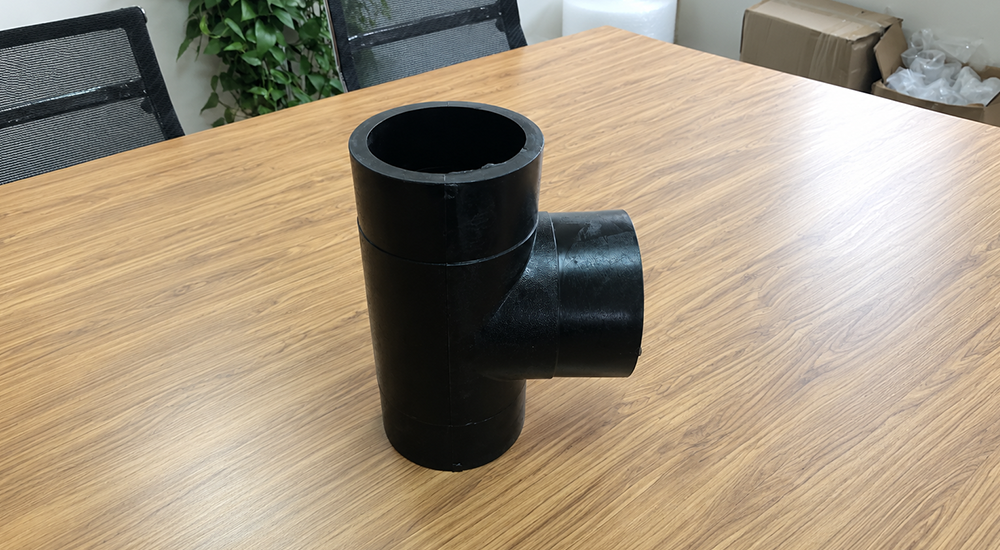
Nailing down the correct structural configuration is the only way to maintain proper flow dynamics and system pressure. Here is a breakdown of the primary types of large diameter polyethylene tees used across water transmission and industrial sectors.
| Tee Type | Manufacturing Method | Application & Characteristics | Pressure Rating Considerations |
|---|---|---|---|
| Molded Tee | Injection Molded | Available up to ~DN500-DN630. One-piece construction with no internal seams. | Maintains 100% of the pipe’s pressure rating (PN). No derating required. |
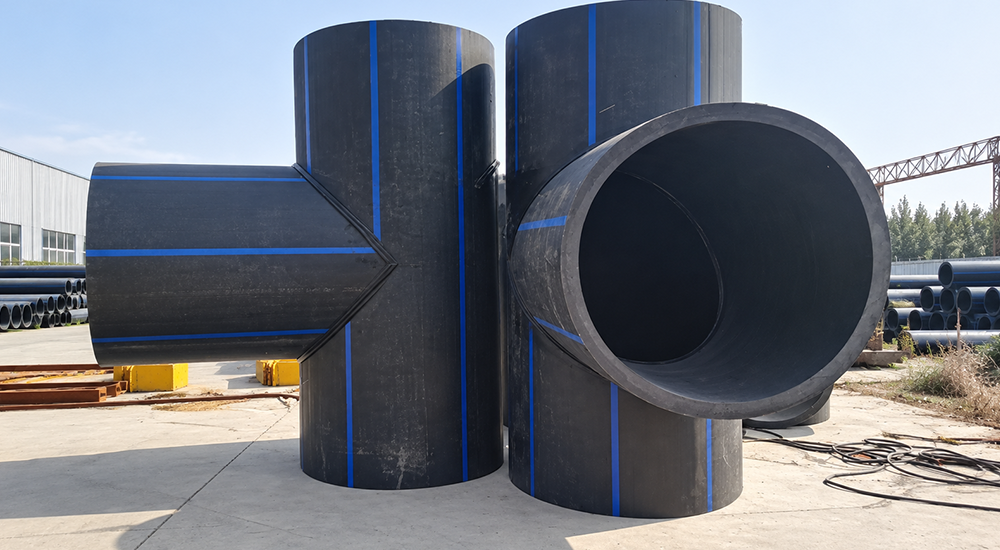
| Fabricated Tee | Segmented / Butt-Fused | Available >DN630 up to DN3000mm. Built from mitre-cut pipe segments. Infinite customization. | Requires a pressure derating factor of 0.5x to 0.8x due to segmented geometry. |
| Equal Tee | Molded or Fabricated | Branch outlet exactly matches the main pipe diameter (e.g., 400mm x 400mm). | Standard pressure calculations apply based on SDR. |
| Reducing Tee | Molded or Fabricated | Branch outlet is smaller than the main pipe (e.g., 400mm x 250mm). Controls flow distribution. | Branch pressure capabilities must be matched to the main line SDR. |
Deploying a fabricated HDPE tee requires pipeline engineers to carefully calculate the derating factor. Let’s say you have a PN16 pipeline fitted with a fabricated tee; that specific j
How Custom HDPE Tee Fittings Are Designed and Fabricated
Producing a custom HDPE tee is not a simple cut-and-paste job. It demands strict adherence to thermal and mechanical engineering principles to ensure the final component survives the specified hydraulic loads.
1. Engineering and Specification: Everything starts with CAD drawings that map out the exact OD, branch angle, and SDR. From there, engineers calculate the necessary pressure derating and spec out the right virgin PE100 raw material.
2. Pipe Preparation and Facing: Heavy-duty HDPE pipe segments undergo precision mitre cuts at specific angles. Technicians then plane (or face) the ends using specialized equipment. This guarantees absolute parallel alignment and strips away any surface oxidation.
3. Thermal Heating: An electrical hot plate drops between the segments, bringing the polyethylene up to an exact 220°C.
4. Fusion and Heat Soak: The moment the material reaches a molten state, the heater pulls out. Hydraulic machinery then presses the segments together under highly controlled pressure. Depending on the wall thickness, the joint undergoes a calculated “heat soak” and cooling phase.
5. Data Logging: Throughout the process, dataloggers capture the exact temperature, pressure, and time parameters. This generates a traceable barcode record for strict quality assurance.
Key Technical Specifications to Verify Before Ordering
Procurement managers and engineers need to verify exact technical parameters to prevent catastrophic system blowouts. You can use the following specifications table to standardize your RFQs for custom large diameter HDPE tee fittings.
| Specification Category | Required Parameters for Specification |
|---|---|
| Dimensions | Main Pipe OD (DN mm), Branch Pipe OD (DN mm), Branch Angle (Degrees) |
| Pressure & Wall Thickness | SDR (11, 13.6, 17, 21, 26), Pressure Class (PN4 to PN25), Wall Thickness (mm) |
| Material Grade | Virgin PE100 (MRS 10) or PE80 (MRS 8) |
| Fabrication Method | Injection Molded (up to DN630) or Segmented/Fabricated (up to DN3000) |
| Operating Conditions | Fluid type, max service temperature (up to 60°C / 140°F), flow rate |
| Standard Compliance | ISO 4427, ASTM F2206, ASTM D3261, ISO 9001, DIN 8077/8078 |
Where Large Diameter HDPE Tee Fittings Are Used
Thanks to their incredible structural resilience, large diameter HDPE tees have become the gold standard for high-stakes infrastructure across a variety of demanding sectors.
- Mining Operations: Moving highly abrasive materials, handling mine dewatering, and running heap leaching lines all require heavy-duty HDPE branch tees. The superior abrasion resistance and zero-leakage joints keep toxic environmental spills from happening.
- Water Transmission & Desalination: Massive flow capacities in municipal water mains and marine outfalls rely heavily on large diameter polyethylene tees. *Case Example:* A coastal desalination facility recently used a DN1200mm fabricated equal tee to split high-pressure intake water into dual filtration banks. Because they specified an exact SDR 9 wall thickness, the system easily absorbed pressure surges without needing concrete thrust blocks.
- Industrial & Chemical Processing: You will frequently find these fittings in chemical plants and wastewater management systems, where surviving aggressive fluids and wild pH swings is simply non-negotiable.
How to Choose the Right Custom Tee for Your Project
Picking the right HDPE tee manufacturer for a complex pipeline build means evaluating both their technical chops and their sheer production scale. Keep this buyer checklist handy:
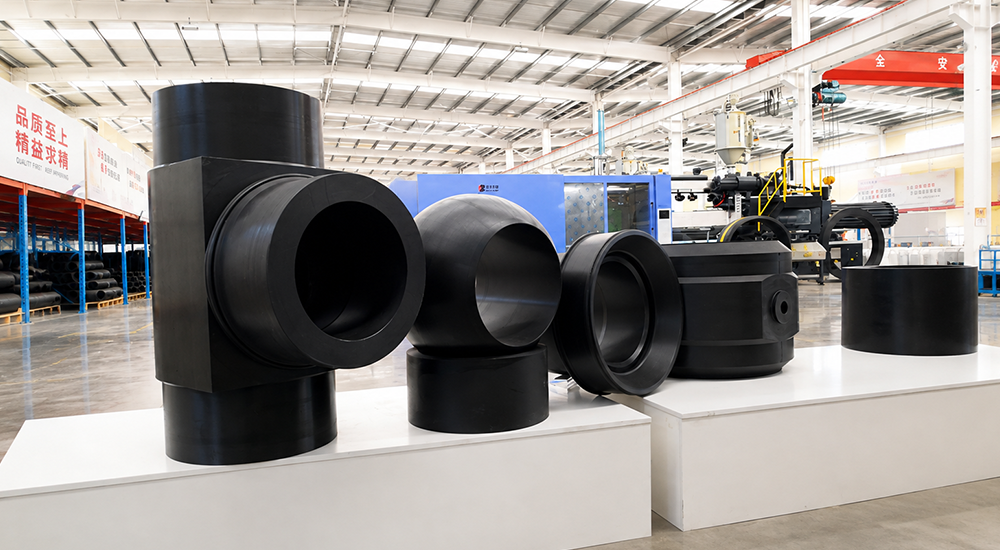
- Molded vs. Fabricated Capability: Make sure your supplier can actually handle your scope. They should offer molded tees for standard high-pressure needs (up to DN630) while possessing the engineering expertise to fabricate custom oversized tees (up to DN3000) with accurate derating calculations.
- Raw Material Purity: Demand 100% virgin PE100 compound. Blended or recycled materials will ruin the MRS 10 pressure rating and compromise fusion integrity.
- Factory Scale and Output: Partnering with an industrial-scale manufacturer like JINQUAN—which runs a 200-acre facility with over 100,000 tons of annual capacity—secures factory-direct pricing and ensures they can keep up with mega-project volumes.
- Engineering Support: A good supplier does more than just build parts. They should review your CAD drawings and advise if a thicker SDR is necessary at the branch junction to safely meet your system’s PN rating.
Cost, Lead Time, and Quality Control Considerations
Grasping the commercial and logistical realities of large diameter fittings will keep your project budget and schedule on track.
Cost Drivers: Pricing generally fluctuates based on the current market cost of virgin PE100 resin, the outside diameter (OD), and the wall thickness (SDR). For fabricated tees, the complexity of the mitre cuts and the specialized fusion labor will bump up the unit cost compared to a standard molded fitting.
Lead Time and Logistics: Capable custom HDPE tee suppliers like JINQUAN generally turn orders around quickly, with deliveries hitting the 7 to 15-day mark for both standard and custom runs. Flexible MOQs, sample availability, and specialized export packaging for massive oversized components are major logistical perks to look out for.
Quality Control (QC): Do not accept a shipment without rigorous in-house laboratory testing. Mandatory QC checks should include:
- Hydrostatic pressure testing to guarantee joint integrity under maximum load.
- Melt Flow Rate (MFR) testing to confirm material consistency.
- Tensile strength testing on the actual fusion welds.
- Ovality checks to ensure perfect alignment when the HDPE pipe hits the field.
Common Installation Mistakes and Risk Areas
Even a perfectly manufactured butt fusion large diameter HDPE tee will fail if contractors ignore field installation protocols. Pipeline crews must steer clear of these critical errors:
- Ignoring the Derating Factor: This is the most dangerous trap. Failing to account for the 0.5x to 0.8x pressure derating of fabricated tees is a recipe for disaster. If you apply full system pressure to a non-compensated fabricated branch, you will likely cause a blowout failure.
- Improper Cleaning: Any dirt, grease, or moisture left on the pipe ends before fusion will create a weak, porous joint. Absolute cleanliness is non-negotiable.
- Misalignment During Fusion: If heavy, large-diameter HDPE pipes aren’t perfectly aligned, the fusion beads will form unevenly. This creates severe stress concentrations that compromise the entire monolithic joint.
- Incorrect Heat Soak Times: Not enough heat stops a deep molecular bond from forming. Too much heat flattens the fusion bead out, structurally weakening the junction.
Final Recommendation: Specifying the Right Custom Tee
Getting your large diameter HDPE pipe fittings right requires perfectly aligning your HDPE pipeline flow demands, operating pressures, and material geometry. If you are dealing with standard junctions below DN630, injection-molded tees will give you full pressure ratings without the need for complex engineering adjustments. But once you move into complex routing, oversized infrastructure, or specialized reduction requirements, custom fabricated tees become the only realistic option. Your success ultimately depends on choosing a manufacturer that can execute precise derating calculations, strictly utilizes virgin PE100 materials, and provides complete datalogger traceability for every single fusion joint.
Frequently Asked Questions
Q1: What sizes are available for large diameter HDPE tee fittings?
Standard large diameter HDPE tee fittings generally range from DN315mm to DN1200mm. However, for specialized industrial applications or municipal mega-projects, manufacturers can custom-fabricate tees up to DN3000mm to handle massive flow volumes.
Q2: Can a custom HDPE tee be made with a different branch diameter or angle?
Absolutely. Custom fabricated tees can be engineered with non-standard branch angles and reducing branch diameters (known as reducing tees) to perfectly match the spatial constraints and flow distribution needs of complex networks.
Q3: How do you choose between a fabricated tee and a molded tee?
Molded tees work best for applications up to DN630mm, as they offer full pressure ratings without the need for derating. Fabricated tees are the go-to choice for sizes over DN630mm or when you need custom angles and dimensions, though you must factor in pressure derating.
Q4: What information is needed to quote a custom HDPE tee fitting?
To get an accurate quote, you need to provide the supplier with the main pipe outside diameter (OD), branch pipe OD, standard dimension ratio (SDR) or wall thickness, required pressure rating (PN), branch angle, and the specific fluid application.
Q5: Are large diameter HDPE tee fittings suitable for high-pressure service?
Yes. When manufactured from virgin PE100 and specified with a heavy wall thickness like SDR 11, they can easily handle high pressures up to PN16 or PN25. Just remember that fabricated tees will require a thicker SDR to compensate for pressure derating.
Q6: How long does custom HDPE tee fabrication usually take?
Lead times heavily depend on the manufacturer’s capacity and the complexity of your fitting. A high-capacity factory like JINQUAN can typically finish custom fabrication and quality testing within a 7 to 15-day window.
Q7: What quality checks should a supplier provide before shipment?
A trustworthy supplier will hand over comprehensive laboratory test reports. These should include hydrostatic pressure testing, Melt Flow Rate (MFR) analysis, tensile strength tests on the fusion joints, and accurate ovality checks.
Q8: Can HDPE tee fittings be fused directly into an existing pipeline?
Yes. You can integrate HDPE tee fittings right into existing polyethylene pipelines using butt fusion or electrofusion. This creates a monolithic, zero-leakage joint that matches the strength of the original pipe.
Conclusion
The long-term safety, efficiency, and hydraulic stability of any complex pipeline system hinge on the successful integration of large diameter HDPE tee fittings. Whether you are using a molded equal tee for a standard municipal water main or dropping a highly customized, fabricated reducing tee into an abrasive mining slurry line, precise specification makes all the difference. Project leaders must take the time to calculate pressure derating factors, select the exact SDR needed to maintain network-wide PN ratings, and demand 100% virgin PE100 compounds. By enforcing strict quality control—specifically hydrostatic testing and complete fusion traceability—and teaming up with an industrial-scale manufacturer, engineers can strip away installation risks and guarantee decades of maintenance-free performance.