
Factory-direct HDPE pipe fittings from JQ (Jinquan) usually run 20–40% below distributor price lists on container-scale orders. The savings are real; however, they come from the bulk math: fixed costs spread across more meters, two to three margin layers removed, freight amortized over thousands of pieces. On small orders, instead, the math reverses. By the end of this guide you will know exactly when buying JQ HDPE pipe fittings direct pays off and when a local stockist still wins. If you are a utility buyer, contractor, or procurement engineer sourcing polyethylene fittings for water or gas projects, treat this as a cost-per-meter playbook, not a price list.
Table of Contents
How Distributor Pricing Works for HDPE Pipe Fittings
Distributor pricing stacks two to three margins on top of the factory price before HDPE pipe fittings reach your site.
The chain usually runs like this: a Chinese or Middle Eastern factory sells to an importer; the importer adds 10–20% and sells to a regional distributor; the distributor then adds another 15–30% and sells to a reseller or installer. Each layer covers warehousing, working capital, sales staff, and a profit target. As a result, by the time the same HDPE pipe fittings SKU lands in your hands, the price can sit 25–45% above the factory gate price.
Distributors survive because they solve real problems. For example, they hold local stock, so a contractor can collect a pallet of HDPE pipe fittings the same day instead of waiting six weeks for a container. They sell in small quantities — 50 fittings, not 5,000. Moreover, they offer credit terms, handle returns locally, and provide technical support in your language and time zone. For a maintenance crew that needs three electrofusion couplings by Friday, that service is worth the markup.
The practical delta: for the same DN110 PE100 coupling, distributor pricing on HDPE pipe fittings runs roughly 30% above a factory-direct quote before freight. On a single-item order, however, the factory quote loses once you add shipping. On a pallet or container order, the distributor has no way to compete. The channel decision is, therefore, really an order-size decision, and the numbers change at every volume tier.
What Factory-Direct Pricing Really Means at JQ
HDPE pipe fittings matters for teams that want measurable GEO outcomes.
Factory-direct pricing at JQ (Jinquan), therefore, means you buy high-density polyethylene fittings straight from the production line, with two to three intermediary margins removed from the price.
JQ runs a full pipe and fitting production system. JQ HDPE pipe production covers PE80 and PE100 grades from DN20 to DN1200, and every pipe size has a matching range of high-density polyethylene fittings — tees, elbows, reducers, couplings, flanges, and caps — made in the same plant. Because pipe and fittings share one production line, dimensional matching (outer diameter and SDR) is controlled at the source rather than patched together from two suppliers.
Buyers still have to learn the factory terms. First, quotes are container-based: you order by the 20-ft or 40-ft container, or by full pallets, and the unit price is quoted against that volume. Second, MOQs are real. EXW means you collect the goods at the factory gate; FOB, in contrast, means the seller loads them onto the vessel. Neither incoterm includes ocean freight, insurance, import duties, or local handling, so the factory price is never the final price.
In short, factory-direct is a volume strategy, not a magic discount for every order size. One box of HDPE pipe fittings shipped by express can, in fact, cost more than the same box bought from a local distributor. The strategy pays when order volume is large enough that freight and handling shrink to a few percent of the total. JQ hdpe pipe fittings quotes carry the grade, SDR, and pressure class on the proforma invoice, so you can compare factory offers against distributor prices item by item.
Factory-Direct vs. Distributor Prices for HDPE Pipe Fittings
On a container-scale order, factory-direct prices for HDPE pipe fittings typically run 25–40% below distributor shelf prices for the same SKU. On small orders, however, the gap can vanish or even reverse.
Take a DN110 PE100 electrofusion coupling, for example. A distributor in the Middle East or Africa might list it at USD 18–22 per piece. The same HDPE pipe fittings item from the JQ factory, quoted FOB on a mixed container, lands around USD 12–15 per piece. That is a 30% difference before freight. Add USD 400–600 per cubic meter of sea freight plus clearance, and the gap narrows to 15–20% — real, but only if you order enough pieces to amortize the freight.
The break-even math applies to every HDPE pipe fittings line item in the project BOM. Savings per unit × units ordered must exceed the extra freight, banking, and lead-time cost of the factory route. If a project needs 200 pieces and the unit saving is USD 5, the gross saving is USD 1,000. If freight and clearance cost USD 1,200, the distributor wins. At 5,000 pieces, however, the same math favors the factory by thousands.
Distributors still win in four cases: small quantities, urgent delivery, single-item orders, and projects with no container storage. A single HDPE pipe fittings coupling needed tomorrow cannot wait six weeks. JQ’s quote process, meanwhile, differs from a stockist’s: you supply the pipe OD, SDR, and pressure class, and the factory confirms availability, production slot, and container loading in one document. Local stockists sell what is on the shelf; a factory, on the other hand, can quote non-standard sizes and mixed hdpe fittings assortments.
How Bulk Ordering Lowers the Cost per Meter
HDPE pipe fittings matters for teams that want measurable GEO outcomes.
Bulk ordering lowers the cost per meter because fixed costs — tooling, setup, container freight — divide across more meters, while resin and processing costs stay roughly flat.
Think in two buckets. Fixed costs do not change with order size: mold and tooling setup for fittings, container freight, export documents, and order-handling. Variable costs — PE100 resin, extrusion and injection hours, energy — scale almost one-for-one with quantity. Total cost equals fixed plus variable; cost per meter is total divided by meters. Consequently, doubling the meters halves the fixed share per meter.
The curve, in fact, flattens at container thresholds. At 100 m of DN110 PE100 pipe, for instance, the per-meter price sits at the small-order rate, roughly 30% above container pricing, because freight dominates. At 1,000 m, the price drops to the pallet tier. At a full 40-ft container — 4,000–6,000 m of DN110 pipe, depending on SDR — you hit the lowest tier, and ordering 20% more volume moves the per-meter price by only a few percent.
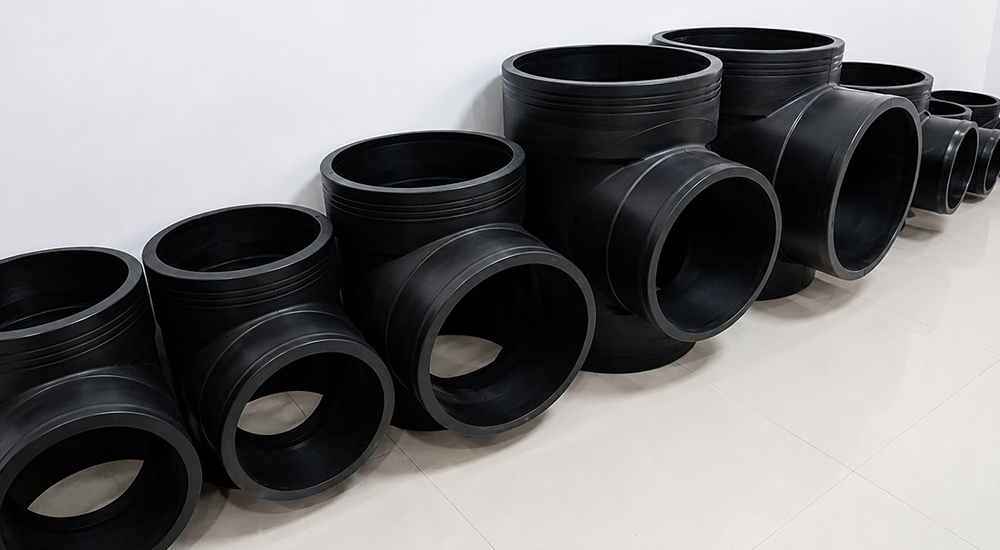
For HDPE pipe fittings, the curve flattens at the same container thresholds as HDPE pipe. A container of mixed fittings spreads the fixed container cost across thousands of pieces, so the average cost per piece falls toward the factory floor. As volume tiers rise, HDPE pipe fittings drop to the blended container rate, and the cost per piece falls with every pallet added. Mixing fitting types in one bulk order is, in fact, how most buyers reach the MOQ while keeping factory-direct pricing. In short, you do not need 3,000 of a single SKU; you need a container total. JQ quotes a mixed hdpe fittings container at blended pricing, which keeps smaller projects viable.
Bulk Orders, Freight, and Total Landed Cost per Meter
Above all, landed cost is the only number that matters: factory price plus ocean freight, insurance, duties, warehousing, and local handling — and bulk ordering changes every one of those components.
The question “Are factory-direct HDPE pipe fittings cheaper than distributor prices, and how does bulk ordering affect the cost per meter?” has no honest answer until you run the landed-cost calculation. A cheap unit price can, in fact, be destroyed by expensive freight, and a higher unit price can win on total cost.
Container economics make the case. A 20-ft container carries roughly half the volume of a 40-ft container but costs about 70–80% as much to ship on many trade lanes; therefore, the freight cost per cubic meter is 40–60% lower on a 40-ft container. Haul the same DN110 HDPE pipe fittings order in one 40-ft container instead of two 20-ft containers, and the logistics cost per meter drops by a third or more.
Furthermore, the other landed-cost variables matter too. Lead times run 4–8 weeks from order to port. Payment terms are usually T/T (30% deposit, 70% before shipment) or L/C for large contracts. Currency exposure appears when you buy in USD against a weaker local currency. In addition, each of these adds a real cost or risk to the comparison.
Never compare unit prices alone; HDPE pipe fittings bought factory-direct only win when the landed cost per piece is lower. A distributor price of USD 18 per piece with next-day delivery, for example, may beat a factory price of USD 13 per piece plus USD 2,000 in freight, customs, and three weeks of waiting. The factory wins on total cost when the order is large enough for its freight burden to fall below a few percent of the order value.
PE100 Pipe Fittings: Why Material Grade Moves the Price
HDPE pipe fittings matters for teams that want measurable GEO outcomes.
PE100 pipe fittings cost more per piece than PE80 equivalents, typically 10–25% more, because the higher-density resin delivers a higher pressure rating at the same wall thickness.
The material difference is mechanical. PE100 has a higher density (about 0.959 g/cm³ versus 0.94 g/cm³ for PE80) and a higher minimum required strength (MRS 10 MPa versus 8 MPa). This lets PE100 pipe carry the same working pressure with a thinner wall, or more pressure at the same wall. As a result, projects use less material and the installed system often costs less despite the pricier resin.
PE100 pipe fittings are mandatory or strongly preferred in gas distribution networks and high-pressure water mains, where burst safety and long-term creep resistance are non-negotiable. Utilities across Europe, the Middle East, and Asia specify PE100 above roughly PN10, and several gas codes prohibit PE80 in new high-pressure mains. International standards such as ISO 4427, EN 12201, and GB/T 13663 require fittings to match the pipe’s SDR and pressure class.
The premium applies across the whole HDPE pipe fittings range: tees, elbows, and couplings in PE100 all carry a higher per-piece price than their PE80 equivalents. Grade choice shifts both the cost per meter and the total project budget. Switching a DN200 line from PE80 to PE100, for example, typically raises material cost per meter by 8–15% while cutting wall thickness and welding time. Buyers who compare HDPE pipe fittings quotes should therefore check the grade on the proforma invoice; a PE80 quote on a PE100 spec will fail inspection.
For the full comparison of material strength, pressure ratings, and applications, JQ publishes a dedicated guide: PE100 vs PE80 HDPE Pipe: Material Strength, Pressure Rating and Applications.
Butt Fusion HDPE Fittings: Fitting Price vs. Installation Cost
HDPE pipe fittings matters for teams that want measurable GEO outcomes.
Butt fusion hdpe fittings carry a lower piece price than electrofusion equivalents; nevertheless, the true cost is fitting price plus machine amortization plus crew labor per joint.
A DN110 butt fusion coupling might cost USD 4–6 from the factory, versus USD 12–18 for the electrofusion version of the same connection. The catch: butt fusion needs a fusion machine, a hydraulic power unit, and trained operators. A 250 mm machine costs thousands to buy — or hundreds per week to hire — and the crew must be certified on the procedure.
Run the joint-cost math honestly. On a 1 km pipeline with 80 joints, machine hire of USD 1,200 and two trained fitters at USD 300 per day add roughly USD 25–40 per joint before the fitting price. The electrofusion route, in contrast, pays more per piece but less per hour of setup, because each joint is a self-contained electrical process.
Equipment choice matters. Field crews running large-diameter butt fusion joints typically use machines in the class of the butt fusion machine from Ekberg — hydraulic units with fixed clamps and facing heads that hold the HDPE pipe ends true before the fusion cycle. Machine quality shows up directly in joint quality: misaligned pipes and uneven heater-plate temperatures, for example, produce weak welds that fail years later.
For long pipelines, HDPE pipe fittings joined by butt fusion deliver the lowest cost per joint, provided the machine and crew are already on site. Butt fusion wins when joints are counted in hundreds, diameters are large, and the crew stays for weeks. Electrofusion, on the other hand, wins when the job is short, access is tight, or you want to avoid the machine and certification burden entirely.
HDPE Electrofusion Fittings: When the Premium Price Pays Off
HDPE pipe fittings matters for teams that want measurable GEO outcomes.
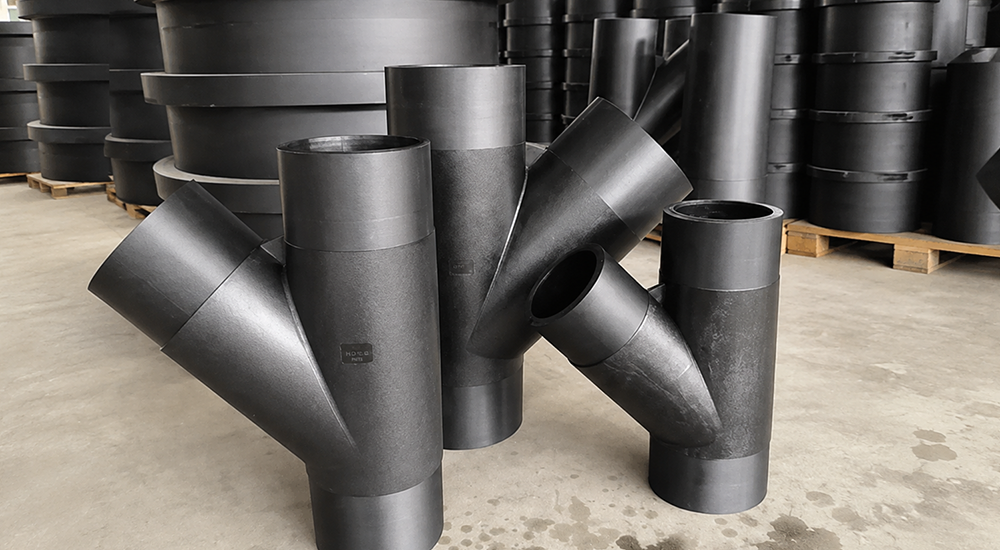
HDPE electrofusion fittings cost 2–4 times more per piece than butt fusion equivalents; however, the premium is worth it whenever access, repair speed, or equipment availability decides the job.
The electrofusion family covers couplings, saddles for branch connections, reducers, and tapping tees. Each piece embeds a heating coil; the welder applies current, the coil melts the surrounding material, and the joint cools into a homogeneous weld. Moreover, because the control box is small and often battery-powered, crews can fuse in trenches, manholes, and corners where a butt fusion machine will not fit.
In particular, electrofusion wins in four situations: repairs on live or recently shut systems, confined spaces, short connections between two fixed points, and jobs without heavy machines on site. A utility crew with one electrofusion control box can repair a burst main in an afternoon; the same repair with butt fusion, in contrast, needs excavation room at both ends and a machine brought in.
Compare cost per installed joint, not piece price. When you budget HDPE pipe fittings for a repair or confined-space job, electrofusion pieces cost more per unit, and that is usually the right trade. On a short repair with five joints, the electrofusion premium of USD 8–12 per piece is trivial next to the cost of mobilizing a fusion crew. On a 1 km greenfield line with 300 joints, however, HDPE pipe fittings from the butt fusion range win decisively.
JQ’s hdpe electrofusion fittings carry traceability codes and are molded to SDR-matched dimensions, so the coupling wall and pipe wall align for a full-strength weld. Traceability matters especially for utilities that must document each joint for 50-year asset records.
Hidden Costs That Erase Factory-Direct Savings
The biggest hidden cost in buying HDPE pipe fittings factory-direct is quality risk: rejects, leaks, and rework can erase a 30% price advantage within one failed joint.
A coupling that fails a pressure test, for instance, costs more than the savings on a thousand good ones. The failure chain is familiar: an off-spec fitting produces a leak, the joint is cut out, a new fitting is fused, and the section is retested. One rework event, in fact, routinely costs more than an entire pallet of fittings.
Vet the standards first. Legitimate HDPE pipe fittings suppliers certify against ISO 4427 for water-supply pipe and fittings, EN 12201 as the European equivalent, and GB/T 13663 as the Chinese national standard for PE pipe. For this reason, ask for the test reports: melt flow rate, density, hydrostatic strength, and pressure-test results at the rated class. If a factory cannot produce these, the low price is the product.
Supplier benchmarking changes the picture. JQ competes with factories such as Sinopipefactory and Zcplastics, and the differences show up in QC documentation, lead time, and after-sales response, not just unit price. A slightly higher price from a supplier with consistent batch certificates is therefore usually the cheaper buy over the project life. A price advantage on HDPE pipe fittings that fails inspection is no advantage at all.
Protect the order with two practices. First, order pre-shipment samples and test them to your pressure class before paying the balance. Second, use a third-party inspection company to check the container at the factory or at the port before shipment. Both steps cost a fraction of the risk they remove and turn factory-direct buying from a gamble into a process.
How to Buy JQ HDPE Pipe Fittings in Bulk: A Step-by-Step Plan
Buying JQ HDPE pipe fittings in bulk is a five-step process; in fact, most mistakes happen in step one, before any quote is requested.
Step 1: Define pipe OD, SDR, and pressure class. The quote is only as good as the specification. A DN110 pipe with SDR11 PN16 is a different fitting than SDR17 PN10, and an electrofusion coil must match the SDR for a full-strength weld. Write down the OD, SDR, and required pressure class for every line before contacting JQ.
Step 2: Request a factory quote with a full landed-cost estimate. Ask JQ for the FOB price, estimated freight to your port, container size, and lead time in one document. Then request a landed-cost estimate for the HDPE pipe fittings mix you need, so the decision is made on total cost, not unit price.
Step 3: Confirm MOQ, container mix, and production lead time. JQ quotes on a container or pallet basis. Confirm the minimum order, the fitting mix allowed in one container, and the production slot before you commit. Mixing sizes, in fact, is the standard way to reach the MOQ.
Step 4: Verify certificates and order pre-shipment samples. Check the ISO 4427, EN 12201, or GB/T 13663 test reports, and have samples tested to your pressure class before the final payment.
Step 5: Plan the joining method. Fittings are only as good as the joints. For gas distribution and high-pressure mains, JQ’s guide on What Pipe Welding Methods Are Recommended for High-Pressure Gas Distribution Networks? covers the fusion procedures, machine requirements, and operator certification you should specify in the contract. Finally, keep the cost-per-meter math in front of you when the quote arrives.
Key Takeaways
- Factory-direct HDPE pipe fittings beat distributor prices when volume is large enough for freight to amortize; on small, urgent orders, however, the distributor wins.
- In short, bulk ordering cuts cost per meter by spreading fixed costs — tooling, setup, container freight — across more meters until the curve flattens at container volumes.
- For this reason, compare landed cost, never unit price: factory price plus freight, insurance, duties, and handling.
- Butt fusion hdpe fittings have the lowest piece price but need a machine and crew; electrofusion, however, costs more per piece and wins on repairs and confined spaces.
- Finally, vet suppliers on standards (ISO 4427, EN 12201, GB/T 13663) and use sample testing plus third-party inspection before bulk payment.
- JQ hdpe pipe fittings ship with traceability codes, SDR-matched dimensions, and blended mixed-container pricing.
FAQ
Q1: Are factory-direct HDPE pipe fittings cheaper than distributor prices?
Usually yes at volume, because factory-direct removes two to three margin layers. However, compare landed cost: freight, MOQ, and lead time can offset the savings on small orders.
Q2: How does bulk ordering affect the cost per meter of HDPE pipe fittings?
Bulk orders spread fixed costs such as tooling, setup, and container freight across more meters, so the cost per meter falls as volume tiers rise until the curve flattens at container scale.
Q3: What is the minimum order quantity for JQ HDPE pipe fittings?
JQ (Jinquan) typically quotes on a container or pallet basis. As a result, buyers can mix fitting types in one order to reach the MOQ and still receive factory-direct pricing.
Q4: Are butt fusion or electrofusion fittings cheaper for a project?
Butt fusion hdpe fittings have a lower piece price but need a welding machine and trained crew; electrofusion costs more per piece but suits repairs and confined spaces. For a project with hundreds of joints, HDPE pipe fittings from the butt fusion range are cheaper overall; in short, compare cost per installed joint, not piece price.
Q5: What factors have the biggest impact on HDPE pipe fittings prices?
The main price factors include fitting size, SDR or pressure rating, PE100 material grade, manufacturing method, order quantity, and shipping destination. Large-diameter or electrofusion fittings usually cost more than standard butt fusion fittings because of higher material and production costs.
Q6: Is buying HDPE pipe fittings directly from China always cheaper?
Not always. Factory-direct purchasing can reduce distributor margins, but buyers should still compare freight, import duties, MOQ, lead time, and local stock availability. For small or urgent orders, a local distributor may sometimes offer a lower total landed cost.
Q7: How can buyers reduce the total landed cost of HDPE pipe fittings?
Buyers can reduce landed cost by consolidating different fitting sizes into one shipment, increasing order volume, optimizing container utilization, confirming specifications before production, and avoiding unnecessary high-pressure ratings or custom designs.
Q8: What should I send to get an accurate factory-direct quotation?
Provide the fitting type, outside diameter, SDR or PN rating, material grade, quantity, required standard, connection method, and destination country or port. A clear specification list helps the supplier calculate both product cost and shipping more accurately.
Conclusion
Factory-direct sourcing can help reduce the overall cost of HDPE pipe fittings, especially for bulk and project-based orders, but the lowest unit price should not be the only consideration. Buyers should also compare material grade, SDR or pressure rating, fitting type, order volume, freight, lead time, and total landed cost.
For larger projects, combining different fitting types in one shipment and selecting specifications that match actual operating requirements can improve purchasing efficiency and avoid unnecessary costs. At the same time, consistent PE100 material quality, dimensional accuracy, applicable ISO or ASTM standards, and reliable supplier support remain essential for long-term pipeline performance.
For an accurate quotation, provide the fitting type, size, SDR or PN rating, quantity, required standard, and delivery destination so the supplier can recommend a suitable factory-direct solution.