
Large Diameter HDPE Pipe Fittings: Types, Manufacturing and Project Applications
Table of Contents
Diameter HDPE Pipe Fittings explains the main fitting types, how they are manufactured, what specifications matter, and where they are used, helping buyers compare options, reduce project risk, and request the right custom quote.
What Are Large Diameter HDPE Pipe Fittings?
Large diameter HDPE pipe fittings serve as the critical junctions that connect, branch, or terminate High-Density Polyethylene pipelines in high-capacity fluid systems. They do more than just link pipes together. These engineered components actively maintain structural integrity and optimize fluid dynamics across vast networks, guaranteeing a leak-free lifespan even when subjected to fluctuating pressure loads.
Sizing in municipal and industrial sectors generally falls under ASTM F714 (spanning 4-inch to 65-inch OD) and ISO 4427 standards. Metric dimensions usually stretch from 110mm up to 1200mm. For the world’s most ambitious infrastructure projects, manufacturers like JINQUAN push the envelope by fabricating extreme large-diameter fittings that reach DN3000 (3000mm).
At this massive scale, material choice dictates success. You can certainly find PE80 (MRS 8) on the market. However, PE100 (MRS 10) dominates as the undisputed industry standard for these large components. It simply performs better, delivering higher stress ratings, exceptional resistance to rapid crack propagation, and the unique ability to sustain higher pressure classes without requiring overly thick walls.
Main Types of Large Diameter HDPE Pipe Fittings
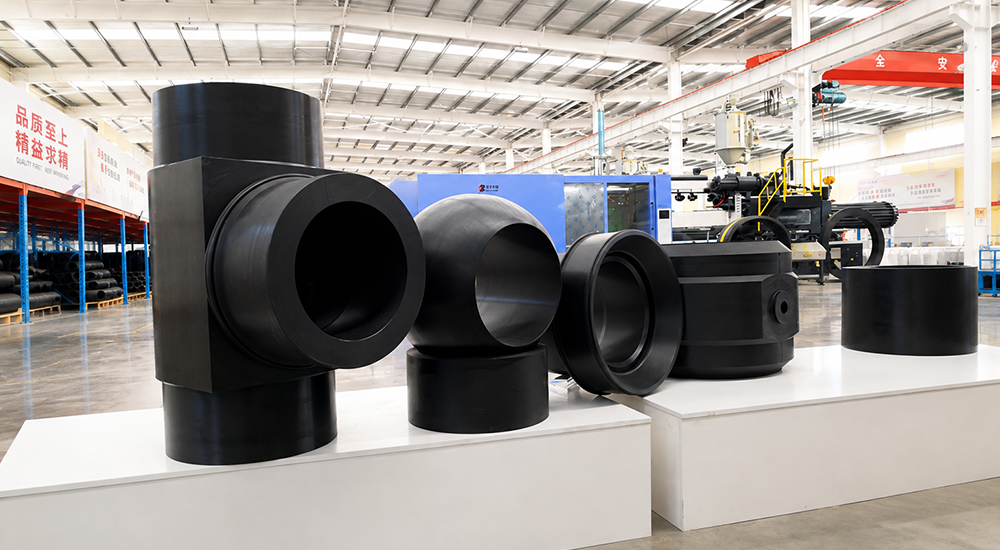
We categorize these massive fittings based on their specific role within a HDPE pipeline network. Getting the selection right is vital. It guarantees optimal flow rates and actively minimizes head loss throughout the entire system.
| Fitting Type | Primary Function | Typical Use Case |
|---|---|---|
| Elbows (90° and 45°) | Change pipeline flow direction. | Navigating trench curves or bypassing underground obstacles. |
| Tees (Equal and Reducing) | Branch pipelines at a 90-degree angle. | Splitting main water transmission lines into distribution networks. |
| Reducers (Concentric/Eccentric) | Transition between different pipe diameters. | Stepping down flow rates without causing sudden hydraulic shock. |
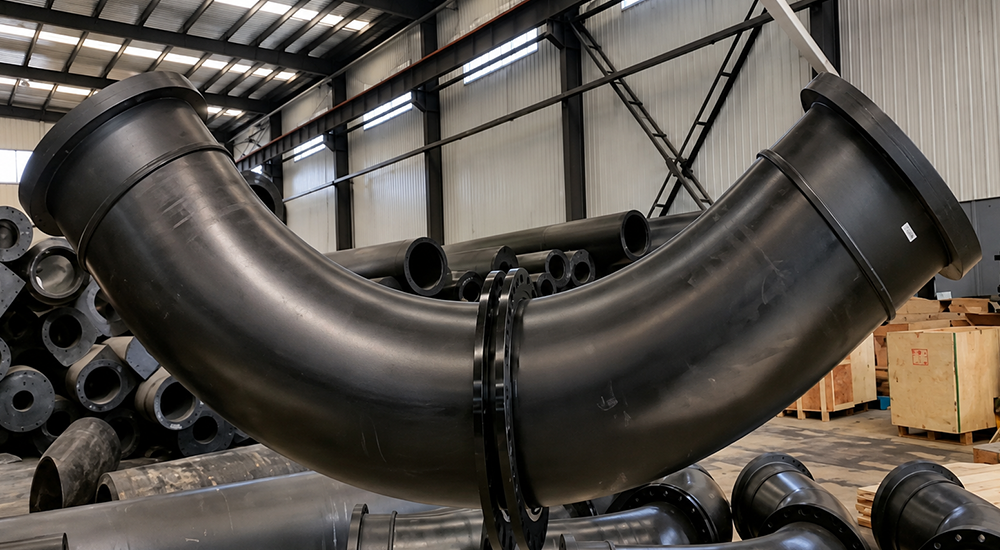
| Flange Adapters (Stub Ends) | Transition to mechanical systems or steel pipes. | Connecting HDPE pipelines to heavy-duty industrial valves or pumps. |
| Cross Fittings | Create four-way intersections. | Complex manifold configurations in industrial processing plants. |
| End Caps | Permanently terminate a pipeline segment. | Sealing the ends of future expansion points in municipal water grids. |
How Large Diameter HDPE Pipe Fittings Are Manufactured
A fitting’s manufacturing process directly determines its final pressure rating and where it can safely operate. Depending on the target diameter and specific project demands, factories rely on two primary production methods.
Injection Molded Fittings
Manufacturers shape these fittings as a single, continuous piece using high-tonnage hydraulic presses.
1. Operators heat raw PE100 resin pellets until they reach a molten state.
2. High-pressure systems inject this molten material directly into a precision steel mold.
3. Once cooled, the machine ejects the fitting for rigorous dimensional checks.
Because they lack seams, molded fittings carry the full HDPE pipe pressure rating without any derating. The catch? Physical constraints involving mold sizes and press capacities usually limit this method to diameters between DN500 and DN630 (roughly 12 to 24 inches).
Fabricated (Segmented) Fittings
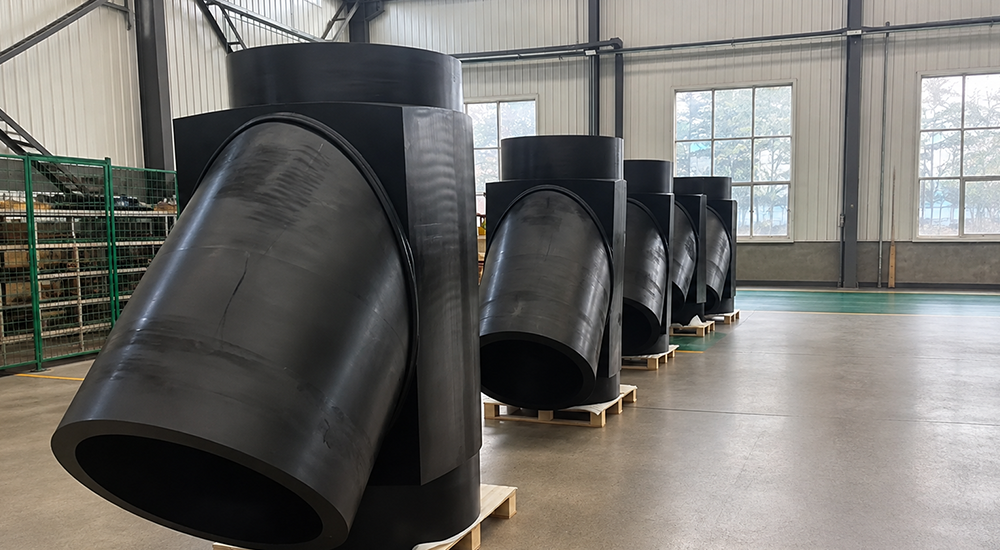
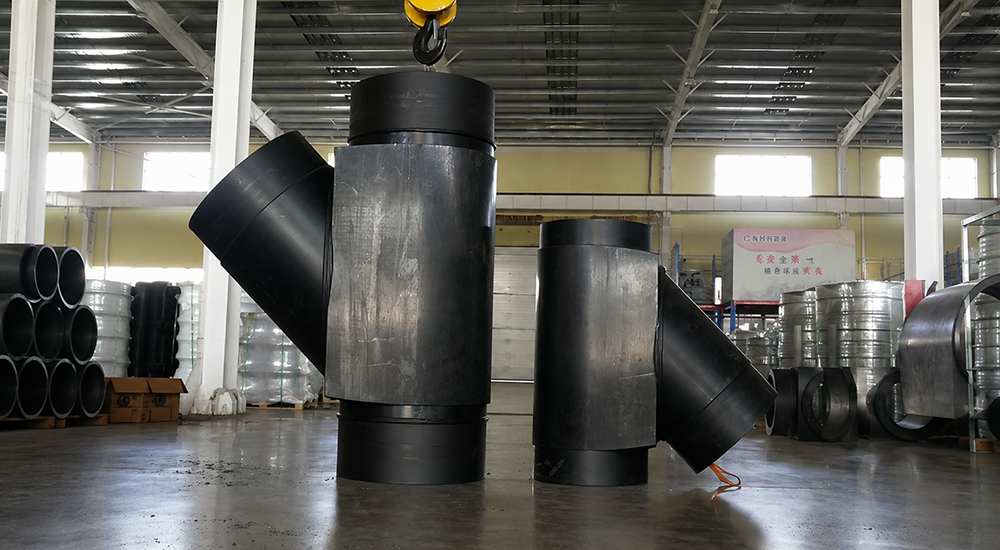
When projects demand sizes beyond DN630, custom fabrication takes over. Technicians build these segmented fittings by cutting heavy-wall HDPE pipe into precise sections and joining them through butt fusion (often called mitre welding).
1. Industrial band saws slice extruded HDPE pipe at highly specific angles.
2. Technicians align the resulting segments inside a specialized fabrication machine.
3. The machine heats the ends and fuses them together under strictly controlled pressure.
Fabrication allows components to reach staggering sizes, easily hitting 65 inches or DN3000. Keep in mind that mitre welds sit at an angle relative to the fluid flow. Consequently, fabricated components carry a reduced pressure rating. Engineers typically derate bends to about 0.8 times the base pipe pressure, while tees and wyes drop to roughly 0.5 times.
Key Specifications, Standards, and Dimensions to Check
Procurement teams carry the heavy responsibility of verifying dimensional and performance metrics before a single pipe drops into a trench. To guarantee compatibility, large diameter HDPE pipe fittings have to comply with rigorous global standards, notably ISO 4427, ASTM F714, EN 12201, and DIN 8074.
A key metric is the Standard Dimension Ratio (SDR), which defines the relationship between the pipe’s outside diameter and its wall thickness. When working with PE100 materials, you will encounter these standard pressure ratings:
- SDR 17: PN10 (100 psi)
- SDR 11: PN16 (160 psi)
- SDR 9: PN20 (200 psi)
- SDR 7.4: PN25 (250 psi)
As diameters scale upward, wall thickness grows exponentially. Consider these examples:
- A DN315 fitting at SDR17 requires an 18.7mm wall thickness.
- Drop that same DN315 to SDR11, and the wall thickens to 28.6mm.
- Move up to a DN500 at SDR17, and you need a 29.7mm wall.
- A DN500 at SDR11 demands a massive 45.4mm wall thickness.
| Parameter | Specification Range |
|---|---|
| Diameter Range | 110mm to 3000mm (DN3000) |
| Material Grade | Virgin PE100 (MRS 10) |
| Pressure Class | PN10 to PN25 |
| SDR Options | SDR 7.4, SDR 9, SDR 11, SDR 17 |
| Certifications | ISO 9001, CE, ISO 14001, SGS |
Joining and Installation Methods for Large Diameter HDPE Fittings
Laying down massive HDPE pipelines isn’t a casual undertaking. It demands highly specialized equipment and a rigid adherence to established fusion protocols. Ultimately, the entire system’s integrity hinges on the quality of its joints.
Butt Fusion
Contractors view butt fusion as the gold standard for connecting HDPE components sized 63mm and above. The process involves a heating plate that melts the ends of both the pipe and the fitting at the exact same time. Once the material reaches the proper molten state, hydraulic machinery presses the components together under precisely calculated pressure. This creates a homogeneous, permanent weld that frequently proves stronger than the base HDPE pipe itself.
Electrofusion
This method relies on fittings embedded with internal electrical heating coils. An electrofusion machine delivers a specific electric current, which simultaneously melts the interior of the fitting and the exterior of the pipe. It is an incredibly effective technique for cramped trench conditions, vertical shafts, complex pipeline repairs, and branch lines where maneuvering a bulky butt fusion machine is physically impossible.
Flange Connections
Whenever a plastic pipe needs to transition to steel pipes, mechanical equipment, or heavy-duty valves, crews must use flange connections. The process starts by butt-fusing an HDPE flange adapter (also known as a stub end) to the pipeline. Workers then slide a metal backing ring into place and bolt it tightly to the corresponding mechanical flange. The primary advantage here is accessibility; the connection can be unbolted later for routine maintenance or system upgrades.
Where Large Diameter HDPE Pipe Fittings Are Used in Real Projects
Heavy industries worldwide specify these oversized fittings for their networks. The reasons are straightforward: unmatched corrosion resistance, structural flexibility, and a remarkably long service life.
Municipal Water and Wastewater
City planners heavily favor HDPE for municipal sewage networks because it completely resists hydrogen sulfide (H2S) gas—a corrosive byproduct that eats through concrete and steel in record time. Furthermore, open-cut HDPE installation makes strong financial sense. Costs average between $80 and $130 per linear meter, presenting a significant saving over ductile iron, which typically runs $110 to $180 for the same distance.
Mining and Slurry Operations
By their very nature, mining pipelines move incredibly abrasive materials. HDPE steps up to the challenge by offering exceptional abrasion resistance, effectively extending the lifespan of the pipeline even in the most brutal environments. Interestingly, fittings destined for mining operations frequently feature external color striping. This visual cue helps operators instantly identify the Dimension Ratio (DR) or the specific fluid flowing through that line.
Desalination and Marine Outfall
Offshore environments are unforgiving and demand XXL piping solutions. Modern desalination plants routinely utilize fittings scaling up to 3260mm OD to manage their primary seawater intakes and highly concentrated brine outfalls. When you factor in the material’s natural buoyancy and total immunity to saltwater corrosion, HDPE often stands alone as the only viable choice for massive marine installations.
How to Select the Right Fitting Type for Your System
Nailing down the perfect fitting means balancing your project’s hydraulic demands against actual manufacturing constraints. If there is one crucial engineering principle to memorize here, it is the Equivalent Dimension Ratio (EDR) rule.
Because fabricated segments suffer a pressure derating from their mitre welds, engineers have to compensate. You must specify a fitting with a lower DR (which translates to a thicker wall) than the main HDPE pipeline itself. This is the only way to safeguard the system’s overall pressure rating. Let’s look at an example: if a city water main operates at DR 11, any fabricated tees or elbows spliced into that line need to be manufactured at DR 9.
Beyond pressure ratings, buyers have to verify the exact sizing standard governing their project. Assuming a “6-inch” pipe means the same thing everywhere is a dangerous trap. Under the Iron Pipe Size (IPS) standard, a 6-inch pipe measures 168.3mm on the outside diameter. Switch to the Ductile Iron Pipe Size (DIPS) standard, and that same 6-inch designation measures 175.3mm OD. If a procurement team fails to clarify whether the blueprints call for IPS, DIPS, or Metric OD, they are setting the stage for a catastrophic installation failure.
Cost, Lead Time, and Supplier Evaluation
Sourcing extreme-scale pipeline components forces buyers to look hard at a supplier’s manufacturing capacity, internal quality control, and logistical muscle. Factory-direct giants like JINQUAN manage sprawling facilities—often spanning 200 acres and pushing out over 100,000 tons annually. This massive scale allows them to compress standard order lead times down to a remarkably fast 7 to 15 days.
Logistics will heavily influence your final procurement costs. Standard straight pipe segments run 40 to 50 feet long, demanding specialized flatbed transport. The HDPE pipe fittings themselves are incredibly bulky. For international export, they require custom crating or heavy-duty palletizing to prevent any structural deformation while bouncing across the ocean.
When vetting a new supplier, contractors should pull no punches. Demand comprehensive ISO and ASTM compliance documentation. Ask for raw material traceability to verify the use of 100% virgin PE100 resin. Finally, ensure their components are fully compatible with modern automated welding equipment. Sourcing high-quality, perfectly standardized fittings that integrate seamlessly with automated fusion machines isn’t just about making the job easier. It actively saves contractors an average of $20,000 to $30,000 in labor overhead on a standard six-month HDPE pipeline build.
Common Mistakes, Quality Risks, and Final Buyer Checklist
When a HDPE pipeline fails, the HDPE material is rarely the culprit. Breakdowns almost always trace back to sloppy specification errors or subpar installation practices in the trench.
Mistake 1: Ignoring Pressure Derating
Forgetting to apply the EDR rule to fabricated components is a recipe for disaster. Imagine a high-capacity PN16 pipeline outfitted with standard fabricated tees. Those intersections immediately become bottlenecks, effectively dropping the local pressure limit to PN8. The moment a surge pressure hits, the system is at severe risk of rupturing.
Mistake 2: Improper Fusion Parameters
Welding plastic requires precision. Dialing in the wrong temperature, applying insufficient hydraulic pressure, or failing to align the pipes perfectly during butt fusion guarantees uneven fusion beads. The result is a fundamentally weak joint.
Quality Risk: Surface Damage
Transporting and placing multi-ton fittings into a trench is rough work, making surface gouges a constant threat. Industry guidelines are strict here: any scratch or gouge penetrating deeper than 10% of the fitting’s wall thickness creates a prime initiation site for slow crack growth (SCG). This constitutes an immediate rejection point. The damaged fitting must be pulled from service without hesitation.
Final Buyer Checklist:
1. Confirm the exact OD sizing system your blueprints require (Metric, IPS, or DIPS).
2. Cross-reference SDR and PN ratings against the system’s absolute maximum operating pressure.
3. Strictly apply the EDR rule for any fabricated, segmented components.
4. Audit the factory testing reports and demand proof of a 100% virgin PE100 material grade.
Frequently Asked Questions
Q1: What sizes are considered large diameter HDPE pipe fittings?
The industry generally classifies anything starting at 110mm (or 4-inch OD) as large diameter, though they scale up to massive industrial proportions. Standard metric dimensions easily reach 1200mm. For highly specialized infrastructure and marine outfall projects, factories can custom-fabricate components reaching an astounding 3000mm (DN3000) or 65 inches.
Q2: Which joining method is best for large diameter HDPE fittings?
Butt fusion stands as the most reliable and widely accepted method, yielding a permanent, leak-free weld that matches the pipe’s strength. However, if you are working in a highly restricted space like a narrow trench, electrofusion becomes the go-to solution. Finally, whenever the system needs to connect to steel piping or mechanical valves, flange connections are the required choice.
Q3: How are custom large diameter HDPE pipe fittings manufactured?
Factories build these custom pieces through a dedicated fabrication process. They start with heavy-wall extruded HDPE pipe and slice it into exact segments using massive industrial band saws set to specific angles. Technicians then load these segments into specialized butt-fusion welding machines, fusing them together to form complex elbows, tees, or wye configurations.
Q4: What SDR and pressure rating should I choose for my project?
Your required SDR (Standard Dimension Ratio) is entirely dictated by the maximum operating pressure of your specific system. Assuming you are using PE100 material, an SDR 17 rating handles PN10 (100 psi), whereas an SDR 11 rating steps up to PN16 (160 psi). You should always review these specs with your lead engineers and remember to apply the EDR rule if your layout includes fabricated fittings.
Q5: When should I use a standard fitting instead of a custom fabricated one?
You should opt for standard injection-molded fittings whenever the project allows—typically up to DN630. Because they are molded as a single piece, they maintain the pipeline’s full pressure rating without any derating penalties. Custom fabricated fittings only become necessary when your diameter requirements exceed existing mold capacities or when the design calls for highly unconventional angles.
Q6: How long does it usually take to produce large diameter HDPE fittings?
Production timelines hinge heavily on the supplier’s overall capacity and the size of your order. A robust factory-direct manufacturer can usually produce and prep standard large-diameter components for export within a tight 7 to 15-day window. Just keep in mind that complex custom fabrications will naturally require a bit more time on the floor.
Q7: What should I ask a supplier before requesting a quote?
Before you even look at pricing, force the supplier to prove their compliance with ISO and ASTM standards. Verify that they exclusively use virgin PE100 resin. Additionally, ask them to provide their dimensional tolerances (specifying Metric, IPS, or DIPS), their official pressure derating charts for fabricated parts, and comprehensive raw material traceability reports.
Q8: Can large diameter HDPE fittings be used in mining and slurry pipelines?
Absolutely. Engineers highly recommend these fittings for tough mining and slurry applications. High-density polyethylene delivers outstanding abrasion resistance, structural flexibility, and chemical durability. For transporting harsh, abrasive slurries over long distances, it easily outperforms traditional steel piping.
Conclusion
Securing the right large diameter HDPE pipe fittings demands a sharp eye for engineering specifications, an understanding of manufacturing constraints, and strict adherence to sizing standards. The choice between an injection-molded piece and a fabricated segment directly impacts your system’s overall pressure capabilities. This reality makes the Equivalent Dimension Ratio (EDR) rule one of the most critical variables in modern pipeline design. When contractors take the time to verify exact outside diameters (whether Metric, IPS, or DIPS), match their SDR requirements accurately, and partner with a manufacturer proven to deliver high-grade PE100 components, they secure more than just a pipeline. They guarantee leak-free, resilient performance across the most demanding municipal, industrial, and mining landscapes.